Gemstone Facts
Gemstone Facts & Information
Stones are listed in alphabetical order. Links to information about American turquoise mines can be found under the turquoise heading on this page. We will continue to add more samples of gemstones in the future.
AGATE & Agate Gemstones
Agate is a member of the Chalcedony species. It's distinctive concentric, banded, shell-like appearance is sometimes enhanced by dying the stone. The bands within this stone are usually multicolored, consisting of fine quartz fibers. Some deposits have a variety of strong to soft color variations like those that had been found in Germany, while others, like the Brazilian Agate, have naturally dull gray bands for which dying will create a more dramatic effect. Since the dye will be absorbed with different intensity, depending on the composition of the bands, it is very difficult to tell the difference between it and naturally colored agate, unless the color used rarely appears normally in nature. This gemstone has been used in all types of jewelry from Victorian jewelry to Southwest Jewelry.
Agate is found as a ball or oblong nodule that can range in size from a fraction of an inch to several yards in circumference. Initial important deposit finds in Germany have been pretty much worked out, but reserves remain in Brazil and northern Uruguay. Other deposits also exist in Australia, China, India, Mexico, Madagascar, Nambia and the states of Idaho, Oregon, Utah, Washington, Wyoming and Montana in the United States.
AMAZONITE & Amazonite Gemstones
This green sodium feldspar has derived it's name from one of it's origins. Or perhaps it's green color conjured up images of the lush green forests of the Amazon, but there are deposits taken from Brazil. This stone can be found in China, India, Kenya, Madagascar, Namibia, Russia and the state of Colorado and Nevada in the United States. In recent years the gemstone Amazonite has been used in all kinds of jewelry from Victorian Jewelry to Southwest Jewelry.
Amazonite is generally opaque and can be sensitive to pressure. This gemstone is sometimes confused for Chrysoprase, Jade or Serpentine.
AMBER, A FOSSILIZED TREE RESIN
PHYSICAL CHARACTERISTICS:
Color is amber yellow to orange.
Luster is resinous.
Transparency: Transparent to translucent gemstone.
Crystal System does not apply because amber is amorphous (meaning it does not have an ordered structure).
Habits include nodules embedded in shales or sandstones and those that are washed up on beaches.
Fracture is conchoidal.
Hardness is 2+.
Specific Gravity is approximately 1.1 (extremely light and can float in salty water).
Streak is white.
Other Characteristics: Can be burned, fluorescent under UV light and is much tougher (will not crumble as easily) than modern tree resins.
Notable Occurrences of this gemstone include all Baltic countries; Venezuela; Russia; Romania; Burma; in coal seams in Wyoming, USA and the Dominican Republic.
Best Field Indicators are color, density, toughness, softness and trapped insects.
THE SWEDISH AMBER MUSEUM
The Swedish Amber Museum in Kämpinge is close to sandy beaches in the southwestern corner of sweden. When the storms begin in the autumn, the local people head for the beach to search for the "Gold of the North". Maps at the museum give a hint about good locations. Anyone can find a pebble, but the 1 kilo pieces and bigger are very rare. Amber from coastal erosion is transported along the shores of all the countries around the southern Baltic Sea. Its weight is slightly heavier than the water in the Baltic Sea. It floats like a soap on the bottom, following the streams until it comes up on the shore or sinks in shallow water. Sometimes it is mined in clay deposits or found among the quartz sand. In saturated salt water it floats. (Melt a couple of spoons of salt in a cup of water and test your amber.)
HISTORY AND TRADE of The Amber Gemstone
The museum shows artifacts from the Stone Age through the Viking Age, to the jewelry of today, from Victorian Jewelry to Southwest Jewelry.
During the Middle Ages, prayer beads were exported as the main product of tooled Baltic amber. From the 16th century into the 18th century, bracelets, necklaces, containers, boxes, bowls, plates, flutes, buttons, mouth pieces for pipes, chess sets, watch cases and even luxury interior fittings were made using amber. The bulk of the amber trade took place in Königsberg and Danzig, modern Russia and Poland, respectively.
In Rome, during the reign of Nero, Romans travelled to the coast of germania to purchase amber. One expedition proved so successful that a special "amber day" was arranged, where this costly item was used to decorate the gladiator games. In the protective netting between spectators and the arena, a glittering amber ornament was placed within each knot and the actual arena was apparently strewn with amber! During that time, the southwest coast of the Baltic Sea was the most important supplier. The Romans maintained regular trade connections with northern Europe along the so called "Amber Routes".
Even earlier, amber was revered by the Phoenicians, who traveled the seaway to what is today the Danish west-coast. Grave-finds from all countries around the Baltic Sea prove that earlier amber was a common trade object to Stone Age man. Since prehistoric times amber has thus been a readily sought after material. Its color, luster, warmth, aroma, electric properties and background, in a scientific sense, place amber in a special category among ornamental stones.
AMBER AND MAGIC
In days gone by, amber was acclaimed to possess the power of healing. Worn as a necklace or charm, or carried around in small bags, amber was believed to be a remedy against such ailments as gout, rheumatism, sore throats, toothache and stomach-ache. It was also believed that amber accelerated birth and was a good remedy against snake bites. To guard against the swapping of a new born baby, the infant it was often given an amber necklace to wear. Amber was supposed to contain magical powers, which is why heart shaped amber charms were carried to offer protection against evil forces and help against witchcraft.
AMBER FACTS
During the Roman times, higher prices were paid for small gemstone amulets in amber than for healthy slaves.
In 79 AD, Plinius wrote that the women of northern Italy wore amber beads against thyroid.
Martin Luther carried a piece of amber in his pocket as a protection against kidney stones.
In ancient China it was customary to burn amber during large festivities. This practice both signified the wealth of the host as well as honoring the guests.
According to Mohammed, a true believer's prayer beads should be made of amber.
The father of healing, Hippocrates, declared amber active against a number of diseases including delirium tremens.
Over 2500 years ago, Thales of Miletos discovered that when amber was rubbed against cloth, sparks were produced and then the amber attracted husks and small wooden splinters. This force was given the name "electricity" after the Greek word electron which means amber.
AUTHENTIC AND FALSE AMBER GEMSTONES
In the display the Amber Museum also explains about how to tell the difference between true, treated and false amber. Amber is often sold heated, melted and pressed or even mixed with or made from synthetic materials.
Most true Baltic amber is milky and pale under the crust. The warm "amber" color occurs first after it has been exposed to oxygen for about a hundred years. To make amber more attractive to the purchases, todays industrial amber jewelry producers are manipulating to get the warm brown-reddish amber color, which often also includes discs, called sunspangles.
The most common method make amber clear is to put the material under pressure and heat in an autoclave together with nitrogen. After this procedure, it is put into an oven to obtain the sunspangles and the cognac color. This heating and treating is made to make amber jewelry more attractive.
Baltic amber occurs naturally in a variety of colors: white, yellow, brown, black, red, green and blue. The most common are honey-colored and milky. A small percentages is bone white, due to microscopic gas bubbles. The clear and translucent amber results from flowing and dripping resin. This kind often shows layers from continuing flow on already dried resin. The black and dirty brown colors are caused by a mix of resin, soil and plant fragments. The most rare have a tone of green or blue caused by gas or inclusions. If the craftsman keeps part of the natural shape, when sanding the raw amber, the crust or inclusions give a natural variety of multicolored tones.
It is possible to melt amber pebbles and press them to bigger lumps. It then becomes harder, and less brilliant when cut. Any color can be added in this procedure. This pressed amber is still considered as natural amber by some producers.
PLASTIC COPIES
Since the bakelite and plastic era began early this century, there has been a number of fake amber qualities in the commercial market. Bakelite necklaces were sold in Europe in the early twenties, when amber was in fashion.
In the markets in Morocco, North and East Africa, as well as in the Middle East and India, amber colored plastic necklaces are very common. They are often sold as antique trade beads. Sometimes they are old, very beautiful, large egg-yolk colored strands, but they are still plastic, and tend to be heavier than amber.
The original, real trade beads, which were distributed from northern Europe around 300 years ago, are very rare to find in the market. It is difficult to see the difference, but if a heated needle is put into the hole of a bead, the smell of burned plastic immediately appears. Baltic amber smells like pine resin.
Even without heating the needle, you can tell the difference. Plastic is elastic, and the needle gets stuck in the material, but true amber is brittle and small pieces will chip off by the pressure.
A scientist from British Museum of Natural History, found a falsification in their collection. A very well preserved fly was described as a palaeontological rarity from the beginning of the 19th century. Someone had divided the piece and carved a concave hole and then put the fly in and covered it with an "amberlike" material before gluing the halves together again.
Since the "Jurassic Park" movie, fortune hunters from all over the world have tried to create attractive plastic-imitations with inclusions, sold as true amber. Sometimes even mammalian hair and feathers are skillfully baked in. They are often carved as a Buddha or other figures, sometimes presented with lumps of the same plastic material with a surface that looks like a natural amber crust. To complete the imitation the faked raw lumps are dipped in oil with a smell of resin.
COPAL, YOUNG RESIN
Resin has always oozed to protect trees all over the world, and the process is still going on. The older the resin is, the harder. It takes millions of years for the resin to harden to amber. When the resin is younger than one million years, it is called copal, a product traded as raw material for varnish and lacquer before the modem synthetic products were developed.
In New Zealand, copal was mined and exported all over the world in the beginning of the century. Today the industrial remains are shown in museums on the North Island. Among the large pieces in the showcases there are quite a few with perfect lizards and giant spiders enclosed, the result of a kind of melting technique used by the miners. There are almost no inclusions in the New Zealand "Kaurigum", opposed to the very fossil-rich copal from East Africa and Colombia.
Copal turns sticky and smells like fresh resin if heated. It does not take a good polish and the crust comes back in a few years. It is transparent in a champagne color and very brittle. There are different sources in many places, varying in age from a couple of thousand years to one million years. Many people love stabilized Copal Amber gemstones.
IS AMBER FOREVER?
Unfortunately, amber is not forever. Roman beads, 2000 years old, have developed a new thick crust. The Baltic amber gemstone jewelry from the last centuries has the fine net of new crust on the surface. It is possible to polish it, but it is very difficult with the faceted gemstone jewelry that was common at that time.
Some amber from the Dominican Republic crusts already after 10-20 years. In Museum für Naturkunde in Stuttgart, germany, their valuable collections of inclusions are preserved in plastic-coating to keep them from the devastating oxygen. Only the amber deep down in geological deposits has "survived" since it oozed from the trees. So, what is found today is only very little of all the resin the trees have produced during millions of years.
"JURASSIC PARK"
In the wake of the movie "Jurassic Park", the interest in amber with inclusions has been increasing rapidly. In the movie, scientists extracted DNA from dinosaur blood enclosed in the stomach of mosquitoes in amber. Through cloning, real dinosaurs were created, and the rest of the story you probably already know. Scientists from the British Museum of Natural History, are now after years of testing, questioning if earlier DNA extractions are conterminated. No successful experiments proved so far.
Most amber found today was formed during the Tertiary Age, about 30-50 million years ago, after the dinosaurs were extinct. In a few places such as Lebanon, New Jersey (USA) and Alava (Spain), amber from the age of the dinosaurs (65-220 million years ago) has been found, but in very small amounts.
REALISTIC SCIENCE
What the movie above all contributed to among scientists all over the world was an increased awareness of how extremely well inclusions in amber are preserved. After millions of years they are visible in three dimensions, showing microscopic details clearly. They may even show behavior or "stories" from the bottom of the prehistoric forests.
The prehistoric conifers, (Pinus succinifera), from which Baltic amber originates, were growing in a subtropical climate in what today is northern Europe. Due to its light weight, Baltic amber was an easily transportable material during the formation of bed deposits during the iceages. Much of the amber found today has been relocated several times. Different kinds of amber are found throughout the world. The amber from Dominican Republic and Mexico comes from a leaf tree, which grew in tropical climate.
USA EXHIBITIONS
After showing our collection of Baltic amber at the Tucson Mineral show, the Amber Museum in Sweden has been invited to exhibit rare specimens at natural history museums all over USA.
In our exhibitions there are many pieces including 40 million year old "frozen stories". Some contain insects trapped in the sticky resin during their mating act; others show behavior like ants transporting eggs or carrying away trapped prey. Other specimens include insects caught by spiders, sometimes wrapped up in webs, microscopic arthropods on rotting leaves, fungus growing on dead substances, pollen falling out of the anthers of a flower, small mites riding on beetles and many more.
These frozen moments from the floors of the prehistoric forests can teach us much about the fauna and flora at that time. Scientists can compare inclusions in amber with todays similar species and study the development through the ages.
The insects in amber are very much the same as the ones living today. Their evolution began 350-400 million years ago. When trapped, they were in the early Tertiary Age (30-50 million years ago), already similar in appearance to today's insects. The mammals were beginning to develop during this era, and a few inclusions of mammalian hair are found, as well as some bird feathers and reptile skin pieces. Recently an entrapped lizard in amber was found in Gdansk-area, Poland.
By
LEIF BROST
Swedish Amber Museum
AMETHYST & Amethyst Gemstones
Amethyst, is a transparent purple gemstone variety of quartz, is one of the best known and most valuable forms of quartz. The name “amethyst” comes from the Greek and means “not drunken”. It was once thought to prevent the wearer from getting drunk and also thought to bring peace of mind.
Amethyst is purple and ranges from light to dark which is caused by iron or manganese compound impurities in the mineral. Amethyst comes from many parts of the world and each locality can produce a unique amethyst to that area or particular mine.
The following is a list of many of the more noteworthy localities and some of the attributes that characterize the amethyst gemstone found there.
Vera Cruz, Mexico -- very pale, clear, prismatic crystals that are sometimes double terminated and have grown on a light colored host rock. Crystals are typically phantomed, having a clear quartz interior and an amethyst exterior. Some are sceptered and phantomed.
Guerrero, Mexico -- dark, deep purple, prismatic crystals that radiate outward from a common attachment point. Often the crystals are phantomed opposite of Vera Cruz amethyst having a purple interior with a clear or white quartz exterior. These are some of the most valuable amethysts in the world.
Minas Gerais and Rio Grande do Sul, Bahaia, Brazil -- crystals form in druzy crusts that line the inside of sometimes large volcanic rock pockets or "vugs". Some of the vugs form from trees that were engulfed in a lava flow millions of years ago and have since withered away. Other vugs are just gas bubbles in the lava. Some vugs can be quite large. The crystals that form are usually light to medium in color and only colored at the tops of the crystals. Most clusters form with gray, white and blue agate and have a green exterior on the vugs. Calcite sometimes is associated and inclusions of cacoxenite are common.
Maraba, Brazil -- large crystals with unattractive surfaces that are of a pale to medium color and often carved or cut into slices.
Thunder Bay, Canada -- a distinct red hematite inclusion just below the surface of the crystals is unique to this locality. Clusters are druzy crusts that line the fissures formed in ancient metamorphic rocks.
Uruguay -- crystals are dark to medium and form in druzy crusts that line the inside of volcanic vugs that have a gray or brown exterior. The crystals are usually colored throughout, unlike the Brazilian crystals, and form with a multicolored agate that often contains reds, yellows and oranges. Often amethyst- coated stalactites and other unusual formations occur inside these vugs.
Africa -- crystals are usually large but not attractive. However, the interior color and clarity are excellent and polished slices and carvings as well as many gemstones are prized and admired.
Maine, USA -- Dark druzy clusters that are not widely distributed today.
North Carolina, USA -- Druzy clusters that have a bluish-violet tint.
Pennsylvania, USA -- druzy clusters that filled fractures in metamorphic rocks. They are generally a brownish purple and patchy in color.
Colorado, USA -- druzy clusters form crusts inside of fissures in sandstone, often on top of a crust of green fluorite. Crystals are dark but rather small.
Italy -- both Vera Cruz like crystals, although not as well defined, and large parallel growth clusters with good evenly distributed color.
Germany -- associated with colorful agates that form a druzy light-colored crust.
Ural Mountains, Russia -- a very clear and dark variety that is cut for fine expensive gemstones, natural uncut clusters are rarely on the market.
Variety of: Quartz , SiO2 .
Uses: Gemstones and ornamental stones.
Birthstone for: February
Color: various shades of purple.
Index of refraction: 1.544-1.553
Birefringence: 0.009
Hardness: 7
Cleavage: none
Crystal system: trigonal
Pleochroic: no
AMMONITE & Ammonite Gemstones
Ammonites are the fossilized, hard shells of extinct mollusks that existed from the Paleozoic to the end of the Cretaceous era. They were abundant in all the oceans. Their closest relative is the chambered Nautilus from the Pacific and Indian oceans. After millions of years the original shell is slowly replaced by minerals such as agate or calcite. Ammonite fossils are found on every continent. They are treasured for their appearance and form. Some show very intricate suture patterns, which are created by the complex walls dividing the inside of the shell.
The Navajos and other Native American Indian tribes carried ammonites in their medicine bags for health and good hunting. They were called Buffalo stones because of their resemblance to the North American Bison. In recent year Ammonites have been used as gemstones in all styles of jewelry from Victorian jewelry to southwest jewelry.
ANYOLITE & Anyolite Gemstones
Anyolite is a member of the Zoisite species. Usually opaque rubies occurring within green zoisite rock with black hornblende inclusions. It's colorful variations make it a beautiful specimen. The first known discovery was in Tanzania in 1954. In recent years this gemstone has been used in all types of jewelry from southwest jewelry to victorian jewelry.
ALEXANDRITE & Alexandrite Gemstones
Alexandrite is a variety of the Chrysoberyl species. It's name is derived from the Russian Czar, Alexander the 2nd who was in power when it was discovered in the 1830s. It's color changing properties, dependant on the light source, are what makes this gemstone unique, and sought after. Larger specimens show their color changing properties best and can be very expensive. Sunlight changes it's hue to green, while showing influences of light red under artificial incandescent light sources.
Although originally discovered in the Urals, that supply has been essentially depleted. Currently mined from Zimbabwe, Sri Lanka and most recently from Brazil. Smaller deposits have also been found in Tanzania, Burma and Madagascar.
Primarily fashioned into faceted gemstones, Alexandrite can be quite expensive. Chemically identical lab created gems are available, having the same color changing properties for considerably less cost. This should not be confused with an artificial gemstone called "Zandrite" which boasts complete color changing properties, but is essentially a specially treated glass. This maybe one of the most expensive and rare gemstones on the market, not much compares to this outrageous gemstone.
APATITE & Apatite Gemstones
Found in many colors, but green is most common. Can be sensitive to acids. Transparent to somewhat opaque, it has a vitreous luster.
Chemistry: Ca5(PO4)3(OH,F,Cl), Calcium (Fluoro, Chloro, Hydroxyl) Phosphate
Class: Phosphates
Group: Apatite
Uses: as a source of phosphorous to be used in fertilizer, rarely as a gemstone and as a mineral specimen.
Specimens
Apatite is actually three different minerals depending on the predominance of either fluorine, chlorine or the hydroxyl group. These ions can freely substitute in the crystal lattice and all three are usually present in every specimen although some specimens have been close to 100% in one or the other. The rather non-inventive names of these minerals are Fluorapatite, Chlorapatite and Hydroxylapatite. The three are usually considered together due to the difficulty in distinguishing them in hand samples using ordinary methods.
An irony of the name apatite is that apatite is the mineral that makes up the teeth in all vertebrate animals as well as their bones. Get it? Apatite - teeth! Anyway, the name apatite comes from a Greek word meaning to decieve in allusion to its similarity to other more valuable minerals such as olivine, peridot and beryl.
Apatite is widely distributed in all rock types; igneous, sedimentary and metamorphic, but is usually just small disseminated grains or cryptocrystalline fragments. Large well formed crystals though can be found in certain contact metamorphic rocks. Very gemmy crystals of apatite can be cut as gems but the softness of apatite prevents wide distribution or acceptance of apatite as a gemstone.
PHYSICAL CHARACTERISTICS:
Color is typically green but also yellow, blue, reddish brown and purple.
Luster is vitreous to greasy and gumdrop.
Transparency: Crystals are transparent to translucent.
Crystal System is hexagonal; 6/m
Crystal Habits include the typical hexagonal prism with the hexagonal pyramid or a pinacoid or both as a termination. Also accicular, granular, reniform and massive. A cryptocrystalline variety is called collophane and can make up a rock type called phosphorite and also can replace fossil fragments.
Cleavage is indistinct in one basal direction.
Fracture is conchoidal.
Hardness is 5.
Specific Gravity is approximately 3.1 - 3.2 (average for translucent minerals)
Streak is white.
Associated Minerals are hornblende, micas, nepheline and calcite.
Other Characteristics: An unusual "partially dissolved" look similar to the look of previously sucked on hard candy.
Notable Occurrences include Durango, Mexico; Bancroft, Ontario; Germany Brazil, Burma, India, Madagascar, Kenya, Mexico, Norway, South Africa, Norway, The United States and Russia.
Best Field Indicators are crystal habit, color, hardness and look.
AQUAMARINE - Colorado's State Stone
It's name means "water of the sea" in Latin because it's color so resembles that of ocean water. Iron creates this color naturally in this stone, but heating specimens with lower iron content will bring out the desired color permanently. When overheated though, it can lead to discoloration. Attempts to improve color with gamma and neutron irradiation can be done, but the changes aren't permanent. Aquamarine can make beautiful faceted gemstones, but jewelers must be very careful when using it for their creations because it can be brittle. It is also sensitive to pressure. Aquamarine is Colorado's state stone. It is the birthstone for March. In recent years this gemstone has been used in all types of jewelry from southwest jewelry to victorian jewelry.
AVENTURINE QUARTZ
Found primarily in dark green with occasional glittery metallic inclusions of green mica or gold-brown to red caused by hematite particles.
Sources are India, Austria, Brazil, Russia and Tanzania. Used by making into cabochons and carved figurines for jewelry and ornamental items.
In recent years this gemstone has been used in all types of jewelry from southwest jewelry to victorian jewelry.
AVENTURINE FELDSPAR - "Sunstone Gemstone"
Aventurine Feldspar (oligoclase), is opaque with glittery gold or red inclusions. Rare occurrences of green or blue glitter are sometimes found. The inclusions causing the sparkle are actually reflections from minute goethite or hematite platelets.
There are deposits found in India, Madagascar, Norway, Canada, Russia and the United States. Generally used by forming into cabochons or other flat surfaces for jewelry, all kinds of jewelry from Victorian Jewelry to Southwest Jewelry.
AZURITE & Azurite Gemstones
Chemistry: Cu3(CO3)2(OH)2, Copper Carbonate Hydroxide
Class: Carbonates
Uses: ornamental stone, pigment, minor ore of copper, and jewelry.
Specimens
Azurite is a very popular mineral because of its unparalleled color, a deep blue called "azure", hence its name. Azure is derived from the arabic word for blue. The color is due to the presence of copper (a strong coloring agent), and the way the copper chemically combines with the carbonate groups (CO3) and hydroxyls (OH). Azurite has been used as a dye for paints and fabrics for eons. Unfortunately, at times its color is too deep and larger crystals can appear black. Small crystals and crusts show the lighter azure color well. Azurite is often associated with its colorful close cousin, malachite
Green malachite is closely associated with azurite in many ways. Not only do they frequently occur together (pictured above), they also have very similar formulae. Malachite can also replace azurite, making a pseudomorph, or an exact copy of an azurite crystal (only now instead of being blue, it would be green). Compare their formulas:
Azurite's formula: Cu3(CO3)2(OH)2
Malachite's formula: Cu2(CO3)(OH)2
The charges on the copper ions are the same for both minerals at positive two (each hydroxide has a charge of negative one and each carbonate has a charge of negative two). But what causes the color change from azurite to malachite if the charge on the copper remains the same? Consider the formulas if they are rewritten as so:
Azurite's formula: Cu(OH)2-2(CuCO3)
Malachite's formula: Cu(OH)2-CuCO3
Notice the different amounts of CuCO3 in the two formulas. The azurite seems to have an extra CuCO3, but the transformation could be explained by an addition of an extra Cu(OH)2 to azurite's formula to make two malachites as in the following equation:
Cu(OH)2-2(CuCO3) + Cu(OH)2 ----> 2{Cu(OH)2-CuCO3}
{AZURITE} 2{MALACHITE}
Since the Cu(OH)2 is more oxidized than the CuCO3, the malachite is therefore more oxidized than azurite. This means that malachite represents a later stage of oxidation and the increased oxidation is what causes the color change. The actual formula for the conversion is a bit more involved and includes the addition of a water molecule to two azurite molecules and the release of a carbon dioxide molecule; leaving behind three malachite molecules. The equation is represented as follows:
2{Cu(OH)2-2(CuCO3)} + H2O ---------> 3{Cu(OH)2-CuCO3} + CO2
2{AZURITE} {WATER} 3{MALACHITE} {CARBON DIOXIDE}
The oxidation is persistent and actually ongoing, although very slow. Azurite paints made centuries ago have undergone the transformation much to the imagined horror of artists whose paintings of beautiful blue skies now have a most unusual green hue! Thankfully for mineralogists and collectors, this transformation is one of the most asthetically pleasing in the mineral kingdom. Although the malachite may soften the sharpness of the azurite crystal, it generally leaves the specimen intact and a whole range of transformations from pure azurite to pure malachite can be obtained. There really is no comparison to any other mineral to mineral transformation in terms of overall beauty.
Azurite is used in jewelry and for dyes as mentioned above. It is also an unimportant ore of copper, although its significance has been more impressive in the past. It is still considered a minor ore of copper; mostly because it is found associated with other more valuable copper ores. Fine crystal clusters, nodular specimens, and interesting and beautiful combinations with malachite are important pieces in anyone's mineral collection. The magnificent color of azurite is worth mentioning again as it truly is a one-of-a-kind in the mineral world. Azurite is one of those classic minerals. This stone has become popular in all kinds of jewelry from Victorian jewelry to Southwest jewelry.
PHYSICAL CHARACTERISTICS:
Color is azure, deep blue or pale blue if found in small crystals or crusts.
Luster is vitreous to dull depending on habit.
Transparency: Transparent if in thin crystals, otherwise translucent to opaque.
Crystal System is monoclinic; 2/m.
Crystal Habits crystals are irregular blades with wedge shaped terminations. Also, aggregate crusts and radiating, botryoidal, nodular and earthy masses.
Cleavage is good in one direction and fair in another.
Fracture is conchoidal and brittle.
Hardness is 3.5-4.
Specific Gravity is 3.7+ (heavier than average).
Streak is blue.
Associated Minerals are numerous and include malachite limonite, calcite, cerussite, quartz, chalcopyrite, native copper, cuprite, chrysocolla, aurichalcite, shattuckite, liroconite, connellite and other oxidized copper minerals.
Notable Occurrences include numerous localities worldwide, but special localities produce some outstanding specimens especially from Lasal, Utah; Bisbee, Arizona and New Mexico, USA; Mexico; Tsumeb, Nambia; Shaba, Congo; Toussit, Morocco; Australia and in many locations in Europe.
Best Field Indicators are color, softness, crystal habits and associations.
CARNELIAN & Carnelian Gemstones
A member of the Chalcedonly species, Carnelian is thought to have been named after the color of the kornel cherry which it likens too. Orange to brownish-red with varieties having some translucency to opaque qualities. Iron contained within the stone gives it this coloring, but heat can enhance it too. Color within this stone is generally dispersed in cloudy patterns. This stone was very popular in Victorian Jewelry.
Found in Brazil, Uruguay and India.
CHROME DIOPSIDE & Chrome Diopside Gemstones
It sounds more like an ingredient a chemist would use rather than a jeweler, but this gemstone is a striking emerald green color. Can react negatively to hydroflouric acid. Will actually melt under a jeweler's torch. This stone is absolutely stunning in Gold Victorian Jewelry styles.
Diopside is russian chrome diopside value a diopside chrome diopside jewelry rough monoclinic chrome diopside diopside mines included pyroxene mineral with composition star diopside MgCaSi2O6. It forms a solid solution series with hedenbergite (FeCaSi2O6) and augite. Diopside is found in mafic igneous rocks as well as in many metamorphic rocks. It is also a constituent of the Earth's mantle.
Gemstone quality diopside is found diopside in two forms: diopside stone the black chrome diopside wholesale what is black star diopside star diopside and the chrome diopside (which includes chromium giving chrome diopside russian diopside chrome diopside beads diopside in greece it a green colour).
Most deposits are found primarily in Russia and Kenya.
CHAROLITE – CHAROITE GEMSTONES
Charoite is a relatively late comer to the marketplace, having been known only since the mid 1970’s. The color of charoite is described as a stunning lavender, lilac, violet or purple. The white chrystalline “needles” give charoite a very distinctive appearance and depth often forming a swirling pattern of interlocking crystals. Charoite is found in the inerfluve of the Chara and Tokkin rivers, northwest of Aldan on the Jakutsk area, northeast of Lake Baikal, Russia. This stone as of late has become very popular in Southwest Jewelry, including inlay.
CHRYSOPRASE & Chrystoprase Gemstones
Chrysoprase is a valuable variety of microcrystalline quartz (chalcedony). Chemically it consists of almost nothing besides silicon dioxide. The green color of Chrysoprase from Australia comes from the traces of nickel within the gem stone. On the Mohs scale of hardness the chrysoprase gemstone measures up at around 6-7.
The chrysoprase gemstone was used to make seals and signets by the Greeks, Romans and Egyptians. During the same time jewellery was also made from the gemstone. Chrysoprase containing jewelry pieces are also recorded from the Victorian era.
As mentioned above, the nickel content in chrysoprase gems gives the gemstone a green color. The green color of chrysoprase from Australia can vary from, very pale green through apple green and into a deeper rich green. The gemstone is generally opaque but, better quality chrysoprase can also be transluscent. The lustre of this gemstone can best be described as vitreous to resinous.
Chrysoprase is quite often opaque, however the more translucent the gemstone the better the quality. There is a very minute quantity of chrysoprase mined that is semi transparent to transparent and this is very highly valued. However most of the good quality commercially traded chrysoprase gemstone is translucent. Chrysoprase from Australia is very easy to work on and takes a fine polish. Good quality chrysoprase would be medium green, tending towards apple green. It would be without cavities and inclusions.
Chrysoprase is very often referred to as Australian Jade. However this is not true and chrysoprase is not jade. Green jade consists of two main categories of gems, one is nephrite and the other jadeite. Chrysoprase however belongs to neither nephrite nor jadeite, it is basically a variety of chalcedony. Good quality chrysoprase can look a lot like high grade jadeite (green jade) but chemically they are poles apart. Chrysoprase is a gorgeous gemstone in it's own right, but don't get fooled into believing that it is jade.
In recent years this gemstone has been used in all types of jewelry from southwest jewelry to Victorian jewelry.
CITRINE & Citrine Gemstones
Citrine is a member of the Quartz species. It is so named due to it's lemon yellow color. Colored by it's iron content, natural specimens are quite rare. Commercial Citrines these days are most likely heat treated Amethyst or Smoky Quartz. Mostly all of heat treated citrines have a slight reddish tint to them. Pale yellow generally denotes a natural stone. In recent years this gemstone has been used in all types of jewelry from southwest jewelry to Victorian jewelry.
Natural-colored citrines are mined from Madagascar, Brazil, Argentina, Burma, Namibia, Russia, Scotland, Spain and the United States.
MEDITERRANEAN CORAL & Coral Gemstones
Coral is one of the world’s few organic gems. The oldest known findings of red coral date from the Mesopotamian civilization from about 3000 B.C. Coral is formed from a colony of marine invertebrates, primarily a skeletal calcium carbonate gem. The formations as seen in the water look like tree branches. Many colors and varieties of coral are found in warm coastal waters from around the world. Coral varies in color: white, pink, orange, red and black. The rarest variety is the blood coral or oxblood coral. This is a very deep red variety. The best oxblood coral comes from the Mediterranean Sea. Coral is usually cabochon cut. Because of its calcium composition coral should not come in contact with acid such as vinegar. Coral has been a staple in Southwest jewelry for decades.
DIAMONDS
Probably the best known gemstone in the world, diamonds have long since been a very valuable item to own. So hard that it constitutes the highest range of "10" on the Mohs' Hardness Scale. Diamond chips that are not of gem quality are often used for the tips of drill bits because of their durability. This hardness is one reason that jewelers find this one of the most difficult gems to cut into a faceted stone, but also one of the most profitable.
A wonderfully beautiful stone when faceted, the refractions from it's many possible cuts make it a favorite of jewelers and customers the world over.
In the past, because of their high cost, many diamond imitations have been tried to duplicate the look for a lesser cost. Natural Zircons were often used as well as other natural colorless specimens of rock crystal, precious beryl, topaz and sapphire to imitate the look or deceive unsuspecting buyers. A most common alternative these days is the lab created Cubic Zirconia, which is shown in the picture above, as it can closely resemble colorless diamonds for a fraction of the cost.
Natural diamonds can be found in a variety of colors. While colorless diamonds are the most valuable, natural colored diamonds can increase value if it is one of the rarer colors of green, red, blue or purple. Yellow diamonds are the most common color found and are sometimes referred to in the trade as "champagne" diamonds.
Diamonds are graded for things like color, clarity, and cut. Inclusions will affect clarity and generally degrade the perceived quality of the stone. The cut of a diamond also affects the price as the complexity of the cut will generally produce a better, more dazzling look, but does add to the cost of preparing the stone.
Naturally colored diamonds are more valuable than treated ones, but treatments like irradiation can change lesser quality diamonds with multiple inclusions into more usable specimens for jewelry.
EMERALD
Emeralds are a member of the Beryl species. Considered a precious stone, it's name has become synonymous with the deep rich green color for which it is known. Chrome contained within is responsible for it's brilliant coloring.
The very best emerald specimens are transparent, but many are clouded by inclusions. Although all emeralds are brittle, stones can be facetted, and most times are. Clear Emerald specimens are very valuable.
FLOURITE CRYSTAL
Fluorite crystals, sometimes called Fluorspar, shows banded color distribution as seen in the rainbow Fluorite Crystals pictured above.
Found in Germany, Burma, Argentina, England, France, Namibia, Austria, Switzerland and the state of Illinois in the United States.
In recent years this gemstone has been used in all types of jewelry from southwest jewelry to Victorian jewelry.
Fossil Mammoth Ivory & Ivory Gemstones
Among the treasures hidden for thousands of years in the remote Arctic tundra of Alaska, Canada and Siberia are the massive ivory tusks of the Woolly Mammoth, ruler of the prehistoric savanna. Larger than today's Indian elephant, their tusks could weigh up to 300 pounds each and measure over 16 feet in length. These great beasts ultimately succumbed to the drastic climate changes accompanying great ice ages. The skeletons and tusks were naturally interred for eons in the frozen earth. We bring this hidden treasure to you as a beautiful gem alternative to new elephant ivory.
These massive tusks are unearthed many ways. Modern day gold miners dredge up mineralized remains in the course of placer mining activities. We unearth fossil ivory during road construction. Bush pilots spot the huge tusks jutting from ever eroding river banks while flying over the tundra. Wilderness explorers find the tusks in the melting muskeg. Regardless of the happy surprise of discovery, all of our ivory is mined in accordance with all applicable federal and state regulations.
The beautiful hues of tan, brown and blue are a result of thousands of years of mineralization. Exact hues depend upon the mineral deposits in the immediate soil surrounding the fallen mammoth. Thus, when processing, each tusk reveals a unique character, never duplicated in another piece of fossil tusks.
International trade in elephant ivory has been largely shut down due to concern for the preservation of a living species. Much to the delight of fine jewelry collectors, fossil mammoth ivory has emerged as an eco-friendly and increasingly valuable alternative. While still scarce and difficult to work with, this lustrous natural ivory possesses the same gem qualities of new ivory, without the stigma attached to illegal harvesting of endangered elephants.
Our supplier has searched out these prized fossils to transform the ancient ivory into lustrous jewelry that reflect the hues of the Arctic landscape. Their skilled craftsmen in Hong Kong, an internationally recognized center for ivory carving, carefully work with the fragile tusks. Each item is painstakingly designed, carved, polished and finished to enhance the unique color of our Arctic Ivory. As with all fine gem quality ivory, the luster is enhanced with frequent exposure to one's natural skin oils, developing a rich patina over time. Ivory has become a huge gem in the southwest jewelry circle, especially used in zuni inlay jewelry.
FOSSILIZED CORAL REEF & Coral Gemstones
The differential nature of uplifted fossilized coral reef on the western end of Roatan Island, Honduras is representative of the ongoing earthquake activity of subsidiary faults along the American/Caribbean plate boundary in Central America. Surveying elevations and mapping the distribution of fringing coral reefs, fossil reefs, wave cut terraces, exposed beach rock, beach sediments, and cave dripstones that have been uplifted and/or tilted by fault movements was performed in an area of approximately 10km2. At five dispersed locations subsurface samples were taken down to a depth of 2.5m. These samples were analyzed by XRD and ESR at intervals of 20cm. Ohio State University’s Nuclear Reactor Lab analyzed selected samples for U, Th, and K content, and also irradiated annealed samples at six intervals of intensity. The irradiated samples were used to establish a regression curve of radiation exposure to ESR signal. Using radionuclide content and this regression curve, ESR signals of field samples were analyzed to estimate their crystallization and/or recrystallization ages. All ESR signals of the field samples were below the limit of resolution of the regression curve (i.e. >20k years). Recrystallization of the coral may have accompanied differential uplift across the study area. Locally as much as 10m of relief can be observed in the beach rock terraces that trend from sea level in the southwest to over 10m in the northeast segment. Differential local and regional uplift coupled with sea level variability have influenced coastal geology and morphology in the study area, and obtaining quantitative results has proved problematic. In recent years this gemstone has been used in all types of jewelry from southwest jewelry to Victorian jewelry.
FOSSILIZED DINOSAUR BONE
If fossilization was simply replacement of bone with stone, fossil and living bones wouldn't be as chemically similar as they are, and the intricate details found in fossilized dinosaur bones would not have survived. Even more intriguing is the fact that some of the proteins in bone have survived the fossilization process, in dinosaurs and "older" fossils, a fact very consistent with a young earth.
Fossilization is essentially a process of denaturing bone, similar to the denaturing of animal skin in leather manufacturing. The mineral that makes the live bone hard, apatite, combines with fluorine (in groundwater) to form fluorapatite. The living tissue in bone (mostly proteins such as collagen) largely decay away, and the resulting void spaces get filled with mostly quartz minerals.
Fossilization takes place when the following steps, which nicely fit a young-earth flood-geology context, occur.
I. Rapid burial to prevent immediate disintegration.
II. Rapid fluoridation and quartzification to spare the bone from bacterial decay and percolating fluids while buried in the sediment. Depending on the mineral content of the groundwater ("the fountains of the great deep" which "burst forth," [Gen. 7:11]) this could have occurred very rapidly. Experiments on buried shrimp show that even soft tissue can be preserved in a matter of weeks under the right conditions.
III. Survival of the bone through chemical change over time ("eons" of survival required, of course, for evolutionists and long-age creationists).
Dinosaur Bone makes awesome jewelry, stunning yellows, reds, and browns, with black. In recent years this gemstone has been used in southwest jewelry and contemporary jewelry and is especially popular in men's rings.
GARNETS & Garnet Gemstones
Garnet actually is a group of minerals with the same crystalline structures which comes in a wide variety of colors. The different varieties are detailed below. In recent years this gemstone has been used in all types of jewelry from southwest jewelry to Victorian jewelry.
Pyrope Garnet: One of the most common varieties (pictured above), it is red in color, often with a brownish tint to it. It has been found in in Burma, Madagascar, China, Sri Lanka, South Africa, Tanzania and the United States.
Rhodolite Garnet: Purplish red or rose-colored garnet.
Almandite Garnet: Named based on the town it was found in, this stone is red with a violet tint. Mined from deposits in India, Brazil, Madagascar and in the United States.
Spessartine Garnet: Also called Spessartite. Named from the word for "forest" where they were found in Germany. It's color is orange to red-brown. Also found in Burma, Brazil, Kenya, China, Sri Lanka, Madagascar, Tanzania and the United States.
Tsavorite Garnet: Green to emerald green in color. The best specimens are clear and are often faceted in emerald cuts. Found in Tanzania and Kenya.
GASPEITE & Gaspeite Gemstones
Gaspeite was discovered in 1966 in the Lemieux Township of the Gaspe’ Peninsula, Quebec, Canada. It is also found in western Australia – the best from North of Perth, Australia. It is found as a secondary mineral around nickel sulfide deposits. Gaspeite comes in light green to an unmistakable apple green color. Gaspiete is usually cut into cabochons. A light, almost apple green color is quite unique and some varieties are almost a neon green. It may contain tan to brownish patches of matrix which gives it a distinctive character. This stone is named for the location of the original discovery in Gaspe Peninsula, Quebec, Canada where material was found that was NOT suitable for the jewelry industry. We only have one source for this treasured stone and he tells us that the last discovery of "cuttable" material (meaning hard enough and of good quality for use in jewelry & beads) was in 1990 in Weegemoogha, Australia. This discovery was a 40 ton block of Gaspeite, with only 27 tons of cuttable material, so YES the availability of this stone will eventually run out to the jewelry industry. It is considered both RARE and collectable. Gaspeite has a hardness of 5.
Chemistry: (Ni, Mg, Fe)CO3, Nickel Magnesium Iron Carbonate
Class: Carbonate
Group: Calcite
Gaspeite is found as a secondary mineral around nickel sulfide deposits. It was thought of as just a gangue mineral by miners when it was encountered and usually placed in the mines dumps or tailings. A gangue mineral is a mineral that probably contains the ore metal, but its chemistry is such that processing it is either impossible or unprofitable. Such was the case with gaspeite despite being rich in nickel. Of course lapidary craftsmen have a different view of gaspeite's profitability! Gaspeite is named for its type locality of Gaspe' Peninsula, Lemieux Township, Gaspe'-ouest County, Quebec, Canada, but the best material of late is coming from North of Perth, Australia. In recent years this gemstone has been used in all types of jewelry from southwest jewelry to Victorian jewelry.
PHYSICAL CHARACTERISTICS:
Color is a pale green to apple green.
Luster is vitreous to dull.
Transparency: Crystals are usually translucent, massive material is opaque.
Crystal System is trigonal; bar 3 2/m.
Crystal Habits include rhombohedrons and scalenohedrons, but crystals are very rare. More commonly found massive.
Cleavage is perfect in 3 directions forming rhombohedrons.
Fracture is uneven.
Hardness is 4.5 - 5.
Specific Gravity is 3.7 (somewhat heavy for a translucent mineral).
Streak is yellowish green.
Other Characteristics: Effervesces slightly in hydrochloric acid.
Associated Minerals include millerite, pentlandite, skutterudite, annabergite and other nickel minerals.
Notable Occurrences include the type locality of Gaspe' Peninsula, Lemieux Township, Gaspe'-ouest County, Quebec and Sudbury, Ontario, Canada and a new source of carvable material from Kambalda and Widgie Mooltha which is North of Perth, Australia.
Best Field Indicators are color, locality, reaction to acids, cleavage and density.
HEMATITE & Hematite Gemstones
Known in some countries as "bloodstone" because of the color it changes the cooling water of saw blades when it's cut, it often resembles metal when polished. The sample above is a Specular Hematite variety with shining specks. When pieces are sliced thin enough, they appear red and transparent. Deposits are found in Bangladesh, England, Brazil, China, Czech Republic, New Zealand and the state of Minnesota in the U.S.A. This gemstone has become extremely popular in beads.
HEMIMORPHITE
Chemistry: Zn4 Si2 O7 (OH)2 -H2O, Hydrated Zinc Silicate Hydroxide.
Class: Silicates
Subclass: Sorosilicates
Uses: minor ore of zinc
Specimens
Hemimorphite is one of the more common sorosilicates. Its most noteworthy characteristic is its polar or hemimorphic crystals from where it gets its name. The crystal structure produces a different termination at each end of the crystal. One termination, the "bottom" is rather blunt being dominated by a pedion face while the opposite end, the "top" is terminated by the point of a pyramid. The crystal structure contains tetrahedrons of ZnO3 OH, interlocked with Si2 O7 groups and water molecules. The zinc is at the center of the tetrahedron while the three oxygens, along with an OH group, are at the four points of the tetrahedron. These tetrahedrons are all aligned in the same direction with one face parallel to the pedion termination and the "top" of the tetrahedrons pointing toward the pyramidal termination.
Hemimorphite was originally named calamine but this name had been used for another mineral and hemimorphite was proposed and is now in wide spread use. The hemi means half while the morph means shape and thus hemimorphite is aptly named. Only a few other minerals show hemimorphic character such as tourmaline, but none show it as well as hemimorphite. Clusters of hemimorphite that show well shaped crystals do not always show the hemimorphic character. Because the crystals of a single specimen tend to grow outward with either the "top" or the "bottom" as the overall orientation for that specimen. In order to see the hemimorphic character either a doubly terminated specimen is necessary or two different clusters with different orientations will be needed.
Specimens of hemimorphite tend to be of two very different forms (seems like a trend with this mineral). One form produces very glassy, clear or white, thin, bladed crystals, often well formed showing many crystal faces. Many times these crystals are arranged in fan shaped aggregates. The other form produces a blue to blue-green botryoidal crust that resembles smithsonite or prehnite. Prehnite has a lower density and is usually greener and has different associations with other minerals. Smithsonite has a shimering luster that causes a play of light across the rounded surfaces and has a higher density that hemimorphite. Often hemimorphite will show rough crystal ridges or "cock's comb" structures over top of the basic botryoidal crust. For a collector both forms are a must in their mineral collections. This gemstone has become extremely popular in beads.
HONEYCOMB CALCITE
Honeycomb Calcite is a beautiful and impressive form of calcite mined exclusively in the state of Utah. Much like onyx and marble it can provide a colorful replacement or a dramatic accent stone for architectural & artistic applications. The name comes from the remarkable honeycomb appearance when viewing a polished surface. It is formed by the growth of long fibrous tubular cells and crystals of honey color outlined by white membranes surrounding each cell. The Coloring is attributed to iron deposits at the time of formation. This gemstone has become extremely popular in beads.
HOWLITE & Howlite Gemstones
Howlite is a white colored stone usually with black matrix. Howlite is often presented in it's dyed form, as shown above. Sometimes used to imitate turquoise, it's natural black or brown veining lends itself well to this. Naturally occurring in snow white coloring, which in this form it is often passed off as white turquoise or "white buffalo". This is one popular stone in the southwest jewelry business.. the most common turquoise imitator these days as well as natural.
IOLITE & Iolite Gemstones
Iolite is normally violet-blue in color, albeit, a sometimes dull blue. The best quality faceted gems can sometimes resemble tanzanite or sapphires. Prior to the 1980s, it was not readily available, but supply has increased, making it a beautiful addition to most jewelry.
It's name is derived from the Greek word for violet. Sometimes misleadingly called a "Water Sapphire" because it looks clear and watery from the side, but can resemble a sapphire when looking at it head on.
Iolite was used by the Vikings on cloudy days as a sort of compass. They were able to locate the position of the sun by looking through thin, clear slices of it. It has properties that acted like a light polarizer and canceled out the mist and haze in the atmosphere. In recent years this gemstone has been used in all types of jewelry from southwest jewelry to Victorian jewelry.
Deposits are found in Sri Lanka, India, Brazil, Burma, Madagascar, Tanzania and the United States
JADE & Jade Gemstones
There have been some civilizations in the South Pacific, Asia and Central America where Jade has been more prized than Diamonds or Gold. It is a very beautiful, yet tough stone that is resistant to chipping and breakage. The ancient Chinese philosopher Confucius said it was valuable because it represented the whole of purity, sureness of intelligence, music and loyalty due to it's characteristics. Today it is worn by many Asians for good luck and health.
The name "Jade" came from the Spanish conquistadors who named it according to the job that native Mexicans were using it for. As it was thought by them to relieve kidney ailments, the Spanish named it "piedra de ijada" which meant "stone of the loins." Eventually the Spanish term evolved into "Jade." The early Roman civilization also considered it to be a good treatment for kidney ailments such as nephritis (kidney inflammation) leading to it being named "lapis nephriticus" for "stone of nephrite." The Latin term was subsequently reduced to "nephrite" and is sometimes used as an alternate name of Jade.
A French chemist, Augustine Damour, noted in 1863 that jade was two different minerals. She used the word "Jadeite" for Burmese jade to distinguish it from the Chinese jade "nephrite." The Chinese had know of the difference between the two since the early seventeen hundreds.
Jadeite and Nephrite are both comprised of tightly interlocking crystals, which is different from the single crystals that comprise most other gems.
Jadeite is a little bit harder and denser and can take more time to polish. It is comprised of crystals which tend to be somewhat more granular and coarse. In recent years this gemstone has been used in all types of jewelry from southwest jewelry to Victorian jewelry.
Nephrite is most common and typically found in olive or forest green. The oldest known sources come from China. It is slightly stronger since it's crystal components are more intergrown than Jadeite.
VARIETY INFORMATION:
VARIETY OF: both jadeite and nephrite
USES: Gemstone and ornamental stone.
COLOR: shades of emerald green as well as white, gray, yellow, orange and violet.
INDEX OF REFRACTION: is approximately 1.66 (jadeite) and 1.62 (nephrite)
HARDNESS: 6.5 - 7
CLEAVAGE: does not apply due to massive nature of jade
CRYSTAL SYSTEM: monoclinic
SPECIMENS
JASPER & Jasper Gemstones
A member of the Chalcedony species, Jasper comes in many different varieties. It's is derived from the Greek word which means "spotted stone." This dense, finely grained stone, can contain up to 20 percent foreign materials which actually determines it's color streak and appearance for categorization. In recent years this gemstone has been used in all types of jewelry from southwest jewelry to Victorian jewelry.
Jasper is found worldwide and comes in colors like red, brown, yellow, gray and green. Black and Blue are the most rare colors found. It comes in many varieties, Agate, Banded, Basanite, Egyptian, Hornstone, Leopard Skin, Moukaite, Picture, Plasma, Scenic, & Zebra Jasper.
JET & Jet Gemstones
Jet is Anthracite Coal which is a sedimentary rock formed from plants that lived millions of years ago. Jet is used a great deal in contemporary and traditional Native American inlay jewelry.
KYANITE & Kyanite Gemstones
It's name is derived from the Greek word for blue. It can often have inclusions and streaks. Having a variable hardness makes it quite difficult to cut. This gemstone has become very popular in beads.
Mined from Brazil, Burma, Kenya, Austria, Zimbabwe, Switzerland and the United States.
LABRADORITE & Labradorite Gemstones
Named after the peninsula in Canada where it was originally found, it's a member of the Feldspar group. Specifically, plagioclase feldspar. It has a luminescent quality, similar to a moonstone, but with more of a streaked design of blues and greens. Some specimens show a more complete rainbow spectrum as well. This quality is best seen when the stone is in just the right direction in relation to the light source because of the distortion created by the microscopic exsoluction lamellae of high and low calcium plagioclase phases. In recent years this gemstone has been used in all types of jewelry from southwest jewelry to Victorian jewelry.
Deposits are obtained from Canada, Madagascar, Australia, Russia, Mexico and the United States.
LAPIS LAZULI & Lapis Gemstones
Lapis has been highly prized since ancient Babylonian and Egyptian times. Genuine lapis is a natural blue, opaque stone. It is brilliant deep blue and sometimes possesses small sparkling gold or silver colored flecks which are pyrite inclusions. The best lapis comes from Afghanistan and Argentina. It can also be found in Russia, Chile, Canada and occasionally the U.S. In recent years this gemstone has been used in all types of jewelry from southwest jewelry to Victorian jewelry and is extremely popular in the zuni inlay jewelry.
LION'S PAW SHELL
Lion's Paw Shell similar to Spiny Oyster comes from Baja Mexico. The interior of the shell has less white and these shells can be orange on one side with purple on the inside thus they make wonderful beads purple and orange, as well as cabochons. In recent years this gemstone has been used in all types of jewelry from southwest jewelry to Victorian jewelry.
MALACHITE & Malachite Gemstones
Malachite is named for the Greek word “mallow” which is a green herb. Malachite is a copper ore that comes in a brilliant green marked with bands of contrasting shades of the same green. Malachite is often found in copper producing areas such as Russia, Mexico, Australia, England, Southwest US and notably Zaire is a major producer today. Never clean malachite with any product containing ammonia. In recent years this gemstone has been used in all types of jewelry from southwest jewelry to Victorian jewelry and is extremely popular in zuni inlay jewelry.
MOTHER OF PEARL
Mother of Pearl is a hard, iridescent inner layer of certain shells such as abalone, pearl oyster and mussel. Mother of pearl varies in shades of white, yellow, pink and gray. Care should be taken not to expose it to chemicals. In recent years this gemstone has been used in all types of jewelry from southwest jewelry to Victorian jewelry.
MOONSTONE & Moonstone Gemstones
Moonstones come in a variety of colors, ranging from colorless to white, gray, brown, yellow, orange, green, or pink. Clarity ranges from transparent to translucent.
Description: (K, Na) AlSi3O8, Moonstone (also called rainbow moonstone) is soft milky white stone, the most valuable variety of feldspar with an rainbow sheen. Moonstone shows a silvery or bluish iridescence, that is caused by the intergrowth of two different types of feldspar with different refractive indexes. The term moonstone also has been applied to the plagioclase feldspars peristerite and labradorite, which also exhibit iridescence.
The name's origin: The moonstone named for its semblance in color to the moon.
Moonstone was very popular with the Romans, who thought it was formed out of moonlight, also used in Roman jewelry since 100 AD. In India moonstone is considered a sacred stone to this day. In recent years this gemstone has been used in all types of jewelry from southwest jewelry to Victorian jewelry.
MUSCOVITE QUARTZITE
Art Smith, Mineralogist-Geologist wrote: I did a microscopic examination of the bead material that you call Muscovite. It is a natural stone, probably a metamorphic rock called quartzite. It is composed of well-fused grains of clear to slightly cloudy quartz with interspersed flakes of pale tan, slightly iron stained, mica that is probably muscovite. The iron staining seems to be most concentrated on the edge of the muscovite flakes and so emphasizes them when the stone is polished. This is an excellent hard and durable stone that will make good beads, cabochons or other lapidary items. This gemstone had become very popular in beads and bead jewelry.
OPAL & Opal Gemstones
Opal is a paradoxical gemstone, and one of the most fascinating.
It is a form of quartz, but is not a form of quartz. Quartz is very common, yet has many rare and precious gem varieties. Opal itself has numerous varieties. It is the most colorful gemstone, but some forms are colorless. It can be very bright and beautiful, and it can be dull and dead. It is best known for its flashes of color, but some varieties have no flashes of color, and are still opals. It can be black, and it can be white. Its best known attribute, the brilliant flashes of many colors, are not called opalescence, but iridescence. Some people think opal is unlucky, but it is one of the most valuable and desirable of gems. Actually because opal is a gel, it is, strictly speaking, not a form of quartz. Quartz is a crystalline form of silicon dioxide, opal is a solid gel. However because the chemical formula is the same except that opal is hydrous, that is it contains some water which is chemically attached to the silicon dioxide molecules. Opals were known and mined in Roman times. The Roman mines were in and around Cervenica, previously in Czechoslovakia, although we have now lost track of all the recent changes in Balkan geography. Now most the opal the market is from Australia or Mexico. Australian opal is the finest. This gemstone has been used in all types of jewelry from southwest jewelry to Victorian jewelry for decades, and is one of the most popular gemstones on the market.
PEARLS & Pearl Gemstones
Color: The color of pearls varies with the mollusk and its environment. It ranges from black to white, with the rose of Indian pearls esteemed most. Other colors are cream, gray, blue, yellow, lavender, green, and mauve. All occur in delicate shades.
Cultured pearls are being produced in virtually every color of the rainbow.
Description: The chief component of the nacre that constitutes the pearl is aragonite CaCO.
Pearls are formed by a mollusk consisting of the same material (called nacre, or mother-of-pearl) as the mollusk's shell. It is a highly valued gemstone.
The shell-secreting cells of the mollusk are located in the mantleof its body. When a foreign particle penetrates the mantle, the cells attach to the particle and build up more or less concentric layers of pearl around it. Irregularly shaped pearls called baroque pearls are those that have grown in muscular tissue. Pearls that grow adjacent to the shell are often flat on one side and are called blister pearls.
Pearls are characterized by their translucence and lustre and by a delicate play of surface color called orient. The more perfect its shape (spherical or droplike) and the deeper its lustre, the greater its value. Only those pearls produced by mollusks whose shells are lined with mother-of-pearl (e.g., certain species of both saltwater oysters and freshwater clams) are really fine pearls. Pearls from other mollusks are reddish or whitish, porcellaneous, or lacking in pearly luster.
The surface of a pearl is rough to the touch. Pearls come in a wide range of sizes. Those weighing less than 1/4 grain (1 pearl grain = 50 milligrams = 1/4 carat) are called seed pearls. The largest naturally occurring pearls are the baroque pearls; one such pearl is known to have weighed 1,860 grains.
Cultured pearl is natural but cultivated pearl produced by a mollusk after the intentional introduction of a foreign object inside the creature's shell.
The discovery that pearls could be cultivated in freshwater mussels is said to have been made in 13th-century China, and the Chinese have been adept for hundreds of years at cultivating pearls by opening the mussel's shell and inserting into it small pellets of mud or tiny bosses of wood, bone, or metal and returning the mussel to its bed for about three years to await the maturation of a pearl formation. Cultured pearls of China have been almost exclusively blister pearls.
The production of whole cultured pearls was perfected by the Japanese. The research that led to the establishment of the industry was started in the 1890s by Mikimoto Kokichi, who, after long experimentation, concluded that a very small mother-of-pearl bead introduced into the mollusk's tissue was the most successful stimulant to pearl production. Cultured pearls closely approximate natural pearls.
The finest Oriental pearls are found in the Persian Gulf. Other notable sources of fine-quality pearls include the Gulf of Mannar between India and Sri Lanka, the waters off Celebes, Indonesia, and the islands of the South Pacific. In the Americas, the Gulf of California, the Gulf of Mexico, and the waters of the Pacific coast of Mexico have yielded dark-hued pearls with a metallic sheen as well as white pearls of good quality.
Freshwater mussels in the temperate zone of the Northern Hemisphere have produced pearls of great value, as for example those from the Mississippi River. Pearling is a carefully fostered industry in central Europe, and the forest streams of Bavaria, in particular, are the source of choice pearls. Freshwater pearling in China has been known from before 1000 BC.
Cultured pearls: Northern Australia established its first cultured pearl farms in the 1960s, that by the mid-1970s were an established industry, producing pearl shell as well as pearls. Japan and Australia are the largest producers of cultured pearls, though Fiji also produces some.
PEITERSITE & Peitersite Gemstones
PIETERSITE is a chatoyant, quartz and crocidolite asbestos. Its appearance is quite different because it's been broken into fragments (brecciated), stirred around if you will, and recemented by silica. The fibers are wavy unlike the gold tiger eye that normally has straight fibers. The resulting patchwork is in shades of blues, yellows, greens, brown, and reds Sometimes areas with clear quartz is also found and I like to cut stones leaving some of the water clear quartz areas when I find them..
Pietersite is named for Sid Pieters, a well-known gem and mineral dealer is from Windhoek, Namibia who imported it to Idar in the 1970s.
One of the major sources of Pietersite is Namibia, an area about 2,000 miles from the tigereye locality in South Africa. It was found as rounded cobbles in the soil on a farm in the neighborhood of Outjo, in the Kuraman district, but its actual source has never been located. It is also reported that it has become vary scarce in Africa and South African authority Windisch says it is all mined out and rarely available from "old" stock.
The other major source of Pietersite is from the Henan Province of China. It made its appearance on the open market in the late 1990's. It was originally found in the 1950's but no one considered using it for jewelry-making. The Chinese had no idea how popular it would become in the rest of the world. This pietersite is very similar to that found in Nambia except that it has more red and golden-red combinations and is narmally more fractured from my experience with the rough.
The Chinese material contains both chrysotile and crocidolite fibers and petrification is very strong. Unfortunately, as the material gets popular, the source is being exhausted and one mine has been reported to have had to close due to ground water flooding it. In recent years this gemstone has been used in all types of jewelry from southwest jewelry to Victorian jewelry.
PERIDOT & Peridot Gemstones
Peridot (pronounced pair-a-doe) is the gem variety of olivine. Olivine, which is actually not an official mineral, is composed of two minerals: fayalite and forsterite. Fayalite is the iron rich member with a pure formula of Fe2SiO4. Forsterite is the magnesium rich member with a pure formula of Mg2SiO4. Olivine's formula is written as (Mg, Fe)2SiO4 to show the substitution of the magnesium and iron. Peridot is usually closer to forsterite than fayalite in composition although iron is the coloring agent for peridot. The best colored peridot has an iron percentage of less than 15% and includes nickel and chromium as trace elements that may also contribute to the best peridot color.
Gem quality peridot comes from the ancient source of Zagbargad (Zebirget) Island in the Red Sea off the coast of Egypt; Mogok, Myanmar (formerly known as Burma); Kohistan, Pakistan; Minas Gerais, Brazil; Eifel, Germany; Chihuahua, Mexico; Ethiopia; Australia; Peridot Mesa, San Carlos Apache Reservation, Gila County, Arizona and Salt Lake Crater, Oahu, Hawaii, USA. The best quality peridot has historically come either from Myanmar or Egypt. But new sources in Pakistan are challenging that claim with some exceptional specimens. The Arizona gem material is of lesser quality, but is far more abundant and is therefore much more affordable. An estimated 80 - 95% of all world production of peridot comes from Arizona. The Myanmar, Pakistani and Egyptian gems are rarer and of better quality and thus quite valuable approaching the per carat values of top gemstones. Possibly the most unusual peridot is that which comes from iron-nickel meteorites called pallasites. Some are actually facetted and set in jewelry.
Peridot is perhaps derived from the French word peritot which means unclear, probably due to the inclusions and cloudy nature of large stones. It could also be named from the Arabic word faridat which means gem. In either case, peridot has been mined as a gemstone for an estimated four thousand years or better, and is mentioned in the Bible under the Hebrew name of pitdah. Peridot gems along with other gems were probably used in the fabled Breastplates of the Jewish High Priest, artifacts that have never been found. The Greeks and Romans referred to peridot as topazion and topazius respectively and this name was later given to topaz, to end the confusion with the two gems. Historical legend has it that peridot was the favorite gemstone of Cleopatra. Pliny wrote about the green stone from Zagbargad Island in 1500 B.C.. Even until recently have jewelers used the term "chrysolite" (latin for golden stone) in referring to peridot gems for some reason. This term has also been used to refer to other gemstones, of a more golden color.
Zagbargad (Zebirget) Island has been known as St John's Island and was mined for centuries. Before World War I, this island was extensively mined and produced millions of dollars worth of gems. Since then the mining has been off and on and at present is all but nonexistent. Still, specimens from here are available at times and it certainly is a classic mineral locality.
Throughout time, peridot has been confused with many other gemstones, even emerald. Many "emeralds" of royal treasures have turned out to be peridots! And although peridot is distinctly a different shade of green, many jewelers refer to peridot as "evening emerald". Emerald is a dark green as opposed to a yellow green and always contains inclusions. Other green gemstones confused with peridot include apatite (which is much softer); green garnets (have no double refraction), green tourmaline and green sinhalite (both of which are strongly pleochroic), moldavites (no double refraction) and green zircon (significantly heavier). All of these gemstones rarely have as nice a yellow component to their green color as does most peridot, but darker green peridot can be confusing when good crystal form is not discernible.
Peridot is a beautiful gemstone in its own right and is widely popular. Its popularity is said to be increasing yearly and with new finds in Pakistan producing exceptionally well crystallized specimens, peridot can be fun to collect for years to come.
PETRIFIED WOOD
Petrified wood consists of a wide variety of minerals including silica, silicates, carbonates, sulfates, sulfides, oxides, and phosphates. They all can permineralize wood to form petrified wood (Adams 1920). However, petrified wood most commonly consists of silica (Si02) in the form of either opal or chert (Stein 1982).
Silicified wood is usually found within one of two types of strata. First, it occurs within accumulations of volcanic ash, tuff, and breccia, e.g. the petrified forests of Yellowstone National Park. Second, silicified wood also occurs within sands, silts, and muds deposited by rivers and streams that have hardened to sandstones, siltstones, and shale. Typically, the sandstones, siltstones, and shales that contain silicified wood also contain redeposited tuffaceous materials or volcanic ash. The silicified wood found in Petrified Forest National Park in Arizona and the Miocene strata of Louisiana and Texas occur within such strata (Knauth 1972:44).
Origin of Petrified Wood
Silicified wood forms in these deposits, because of the presence of dissolved silica within the groundwater. The silica is derived from the dissolution of the volcanic material by the groundwater within the volcanics or sediments. This dissolved silica in the form of monomeric silicic acid attaches itself to the lignin and cellulose of the wood. With time, a layer of the monomeric silicic acid forms on the exposed woody tissues. The monomeric silicic acid dehydrates into silica gel. Additional layers of the monomeric silicic acid attach to this silica gel eventually filling and encasing the wood with silica gel. A rapid loss of water converts the silica gel into amorphous silica (opal) (Leo and Barghoorn 1976; Scurfield and Segnit 1984).
Within 10 to 40 million years, the opal of the silicified wood further dehydrates and crystallizes into microcrystalline quartz (chert). Factors such as temperature and pressure may speed or slow the process, but eventually the opal of the silicified wood becomes chert (Stein 1982). During the change from opal to chert in silicified wood, the relict woody texture may either be retained or lost.
During the silicification process, various materials and minerals may be incorporated into the silica gel. For example, manganese dioxides, iron oxides, organic matter and authegenic clay can alone or in combination color the opal or chert that forms silicified wood. Because each piece of wood becomes silicified in its own local geochemical environment, the trace and major materials and elements that it contains will vary greatly from piece to piece even within the same stratum (Knauth 1972:45; 1981). Therefore, trace element analysis is generally useless in tracing the source of any silicified wood.
Types Of Petrified Woods
Within the Tertiary strata that outcrop in southeast to southwest Texas and into Louisiana, three types of silicified wood can be recognized. They are rather nondescript silicified wood, palm wood, and a massive silicified wood. The nondescript silicified wood consists of silicified wood that possesses a recognizable woody structure. The relict woody structure is fine and nondescript. It is not identifiable without oriented thin sections, specialized references, and comparative material (Blackwell et al. 1983:2). Therefore, this type is best described just as "silicified wood".
The second type of silicified wood is commonly called including the State Fossil "petrified palm wood" by geologists and rock collectors. Palm wood is a group of fossil woods that contain prominent rod-like structures within the regular grain of the silicified wood. Depending upon the angle at which they are cut by fracture, these rod-like structures show up as spots, tapering rods, or continuous lines. The rod-like structures are sclerenchyma bundles that comprise part of the woody tissues that gave vertical strength to the Oligocene and Miocene tree genera, Palmoxylon (Blackwell et al. 1983:4-5).
The third type of silicified wood is massive silicified wood. The silicification of the wood or subsequent transformation of silica gel to opal or chert has obliterated any trace of the grain of the former wood. The destruction of the structure of the silicified wood has resulted in a massive opal or chert that lacks any visible indication of its origin. Because of its variable, massive nature and heterogeneous trace element composition, many investigators, e.g. Jolly (1982) and Jolly and Kerr (1984), have often failed to recognize the nature of this material. The Eagle Hill Chert found within West-Central Louisiana is a local, massive silicified wood (Heinrich 1984). A similar massive silicified wood called "golden palm" occurs in equivalent strata within East-Central Texas (Patterson 1985).
PICASSO MARBLE
A gorgeous stone native to southeastern Utah. Utah Picasso Marble is a common building stone, it is a classic sculptors stone. Some marbles are famous such as Italian white and Belgian black marble. The colors vary and may be found in pinks, yellows, and browns. Marble is a soft rock and yet dense in structure. It was once limestone in the Precambrian era. The sedimentary limestone masses were sometimes contacted by hot magnas and the pressure altered the limestone. Other minerals from the magna then infiltrated the limestone causing feathery lines and beautiful designs such as Picasso Marble found in Beaver County, Utah. The scenic effect and color contrast in black and gold has made this marble a popular cutting rock for the lapidarest. In recent years this gemstone has been used in all types of jewelry from southwest jewelry to Victorian jewelry.
RAINBOW CALSILICA
is a newly-found, multi-colored, layered stone composed of calcium and silica from a mine in Chihuahua, Mexico. This stone has been recently used for Zuni fetish carvings and in Native Indian jewelry. I am not too sure of the reality of this stone, I have heard rumors that it is just colored sand layered and treated like they treat turquoise. In recent years this gemstone has been used in all types of jewelry from southwest jewelry to Victorian jewelry.
RHODOCHROSITE & Rhodochrosite Gemstones
Rhodochrosite (whose name means rose-colored) is a very attractive mineral with an absolutely one-of-a-kind, beautiful color. Although it can be an ore of manganese, it is its ornamental and display specimen qualities that make it a very popular mineral. The color of a single crystal can just astound the observer with its vivid pink-rose color that seems to be transmitted out of the crystal as if lit from within.
Individual crystals are found in well shaped rhombohedrons and more rarely scalahedrons. In a massive form its pink and white bands are extremely attractive and are often used in semi-precious jewelry. Rhodochrosite is often carved into figurines and tubular stalactitic forms are sliced into circles with concentric bands that are truly unique in the mineral kingdom. Fine crystals are sometimes cut into gemstones, but rhodochrosite's softness and brittleness limit it as a gemstone for everyday use.
Identification of rhodochrosite is fairly easy despite a few similarly colored minerals such as rhodonite. Rhodonite is harder and has different cleavage; but perhaps the best distinguishing factor is its lack of reaction to acids. Rhodochrosite will easily with show some reaction to cold acids which demonstrates its carbonate chemistry. Basically, any rose-pink carbonate is considered rhodochrosite; however some calcites with a small amount of manganese impurities can be pink in color. The manganese replaces some of the calciums in calcite but a complete series between calcite and rhodochrosite is not established. Differentiating pink calcite from rhodochrosite may require a fluorescence test as rhodochrosite is distinctly non-fluorescent and manganese is a fluorescent activator in calcite.
There are many localities for rhodochrosite that are of great reknown. Beyond a doubt, the best locality for rhodochrosite is the Sweet Home Mine in Colorado. It is unmatched for its superb rhodochrosite crystals that exhibit the best features of the species; a fine bright rose color and sharp well formed crystals. Some specimens from here are quite large and of world class distinction.
Other localities have produced some fine specimens as well. Catamarca, Argentina has an old Inca silver mine that has produced fine stalatitic examples of rhodochrosite that are unique and very attractive. Cut cross-sections reveal concentric bands of light and dark rose colored layers. These specimens are carved and used for many ornamental purposes.
Mont Saint-Hilaire, Quebec, Canada has produced many fine rare minerals but it also produces some nice rhodochrosite specimens as well. Specimens from here are generally small, but have a good color and are associated with rarer minerals.
There are many Peruvian rhodochrosite localities that have produced a number of good specimens. These crystals are usually paler in color than other specimens, but are accented by interesting metal sulfide minerals.
N'Chwanging Mine, Hotazel, South Africa has produced possibly the best examples of scalahedral crystals of rhodochrosite. The unusual crystal habit is due in part to this being one of a few sedimentary crystallizing environments for the species. Most other localities are the result of metamorphism, late stage igneous intrusion or more commonly hydrothermal precipitation. In recent years this gemstone has been used in all types of jewelry from southwest jewelry to Victorian jewelry.
RHODONITE & Rhodonite Gemstones
Chemistry: (Mn, Fe, Mg, Ca)5(SiO3)5 , Manganese Iron Magnesium Calcium Silicate.
Class: Silicates
Subclass: Inosilicates
Group: Pyroxenoid
Uses: ornamental and semi-precious stone and as a minor ore of manganese
Specimens
Rhodonite is an attractive mineral that is often carved and used in jewelry. It is named after the Greek word for rose, rhodon. Its rose-pink color is distinctive and can only be confused with rhodochrosite and the rare mineral, pyroxmangite, MnSiO3. Rhodochrosite however is streaked with white minerals such as calcite and is reactive to acids. While rhodonite does not react to acids and is usually associated with black manganese minerals and pyrite. Pyroxmangite is a little harder to distinguish because the two minerals are closely related and x-ray studies are usually needed when found massive. Crystals of pyroxmangite are often twinned as is not the case with rhodochrosite crystals. Crystals of rhodonite, while not in nearly the same abundance as massive rhodonite, are still found and distributed on the mineral markets. They come from a few notable localities and are considered classics by collectors.
RUBY & Ruby Gemstones
Ruby is the red variety of corundum, the second hardest natural mineral known to mankind. The non-red variety of corundum is Sapphire Sapphires are well known among the general public as being blue, but can be nearly any color. The red color in ruby is caused by trace amounts of the element chromium. The best shade of red for ruby is often given the name "pigeon blood red", but ruby can be any shade of red up to almost pink.
Oriented rutile crystal inclusions cause a six-rayed-star light effect (called asterism) to form the popular Star Ruby.
Rubies come from all over the world but good gemstones are found at Thailand, India, Madagascar, Zimbabwe, North Carolina in the U.S., Afghanistan, Pakistan, Sri Lanka, Kenya, Tanzania, Kampuchea, and perhaps most notably, Burma.
Rubies have a famous place in science - the first lasers were made from artificial ruby crystals. They still are used for this purpose although other materials offer improved efficiency. Some ruby crystals show the fluorescence (actually very short term phosphorescence) that makes a laser possible. Nothing is higher than Ruby in the Thai culture for Jewelry.
SAPPHIRE & Sapphire Gemstones
Sapphire is the non-red variety of corundum, the second hardest natural mineral known to mankind. The red variety of corundum is Ruby. Sapphires are well known among the general public as being blue, but it can be nearly any color, even colorless. White (or colorless but massive) sapphire would more properly be called corundum. The blue color is by far the most popular color for sapphire but orange-pink, golden, white, and even black have generated much interest in the gem trade. Oriented rutile crystal inclusions cause a six-pointed-star light effect (called asterism to form the popular Star Sapphire. In recent years this gemstone has been used in all types of jewelry from southwest jewelry to Victorian jewelry.
VARIETY INFORMATION:
VARIETY OF: Corundum , Al2O3 .
USES: Gemstone.
BIRTHSTONE FOR: September
COLOR: various colors, except for red.
INDEX OF REFRACTION: 1.76 - 1.78
BIREFRINGENCE: 0.009
HARDNESS: 9
CLEAVAGE: none, although there is a rhombic parting
CRYSTAL SYSTEM: trigonal
PLEOCHROIC: strongly
SEPTARIAN NODULES
Utah Septarian Nodules – Septarians were formed millions of years ago when the Gulf of Mexico reached what is now Southern Utah. Decomposing sea life, killed by volcanic eruptions, had a chemical attraction for the sediment around them, forming mud balls. As the ocean receded, the balls were left to dry and crack. Because of their bentonite content they also shrank at the same time trapping the cracks inside. As decomposed calcite from the shells was carried down into the cracks in the mud balls, calcite crystals formed. A thin wall of calcite was transformed into aragonite separating the bentonite heavy clay exteriors from the calcite centers. Because of this, the nodules are called Septarians.
SEREPHINITE
Hails from Russia and is the cousin of Charoite. Serephinite is a relatively late comer to the marketplace, having been known only since the mid 1980’s. The color of serephinite is described as a stunning emerald, forest green with metallic looking chrystalline patterns that look like a candy pant job on a car. The white chrystalline “needles” give charoite a very distinctive appearance and depth often forming a swirling pattern of interlocking crystals. Some call this look "chatoiant". Serephinite is found in the inerfluve of the Chara and Tokkin rivers, northwest of Aldan on the Jakutsk area, northeast of Lake Baikal, Russia. In recent years this gemstone has been used in all types of jewelry from southwest jewelry to Victorian jewelry.
SPINY OYSTER SHELL
Spiny Oyster Shell, Spondylus Brodnip Princess, is found in the Sea of Cortez, Baja California, Mexico. Spiny Oyster began to be exported for jewelry making in the Southwest in 1976. The shell comes in three main colors: red, orange, purple and sometimes white and yellow.
The name Spondylus is a Latin word that means “spines on its back”. Brodnip was the name of the scientist who traveled with Cortez when Baja California was explored. The name “princess” was given to the shell when Cortez presented his marine discoveries to the King of Spain. The king’s daughter fell in love with the shell; thus, it was named after her. In recent years this gemstone has been used in all types of jewelry from southwest jewelry to Victorian jewelry and super hot in Zuni inlay jewelry.
SODALITE & Sodalite Gemstones
Sodalite is a scarce mineral that can be rock forming. Sodalite is named in reference to its sodium content. It is used for carvings and some jewelry pieces. Its light to dark pure blue color is well known in the semi-precious stone trade. Sodalite is a member of the feldspathoid group of minerals. Minerals whose chemistries are close to that of the alkali feldspars but are poor in silica (SiO2) content, are called feldspathoids. As a result or more correctly as a function of the fact, they are found in silica poor rocks containing other silica poor minerals and no quartz. If quartz were present when the melt was crystallizing, it would react with any feldspathoids and form a feldspar.. Localities that have feldspathoids are few but some produce large quantities of sodalite. Sodalite, when not blue, is hard to distinguish from other feldspathoids. It is the only feldspathoid that contains chlorine. Sodalite dissolved in a dilute solution of HNO3 gives a positive chlorine test obtained from some swimming pool test kits. In recent years this gemstone has been used in all types of jewelry from southwest jewelry to Victorian jewelry.
SUGILITE & Sugilite Gemstones
Sugilite (aka Royal Azel, Royal Lavulite, Purple Turquoise, Luvulite, Gem Sugilite, Royal Lazelle) is a somewhat obscure mineral named for the Japanese geologist who discovered the first specimen in 1944, Ken-ichi Sugi. It is a potassium sodium lithium iron manganese aluminum silicate (now that's a mouthful!). Sugilite forms in syenite, a rock that was created through volcanic activity deep beneath the earth's surface. It is usually opaque with a waxy luster but can be translucent. It often has brown, pink and white inclusions, looking like a purple version of turquoise (though the two minerals are unrelated). The most valuable sugilite is a deep purple or reddish purple — colors it derives from manganese. However, some sugilite is gray, white or yellow. These color variations are caused by quartz or various silicate materials present. Warm soapy water is the best cleanser for this gemstone, as it is risky to clean sugilite by ultrasonic machine or steaming. Sugilite has been called the stone of the New Age. The variety Professor Sugi first discovered in Japan in 1944 was a light brownish yellow. The second known occurrence of sugilite came in 1955, when a single dark-red ore specimen with pink crystals across its surface was found in central India. However, this specimen was not identified as sugilite until many years later. It was not until 1975 that sugilite was discovered in a significant quantity: a thin, bright-magenta band running through a core sample obtained at a manganese mine in South Africa, near a small desert town called Hotazel. Though this was a low-grade ore, by 1979 a major deposit of gem-grade sugilite was exposed in the area. Most of this original material has since been used up, making quality sugilite a relatively rare item on the market. Only a few, much-smaller finds have followed. Sugilite is considered a great balancer of mind, body and spirit, and is said to attract healing power. Mystics say it helps with self-forgiveness and brings forth acceptance and belief in oneself. It also is said to eliminate hostility and infuse the being with inspiration and confidence. Yoga enthusiasts believe sugilite stimulates the crown chakra and aids in opening all the chakras, allowing for the movement of Kundalini energy. It is highly regarded for centering spiritual light into the body and drawing out both physical and emotional pain. Sugilite seems to protect against, absorb and dissipate anger. Many also believe it will heal headaches and discomforts, simply by holding it. Sugilite is found on Iwagi Island in Japan, Canada (Quebec) and most importantly, South Africa. In recent years this gemstone has been used in all types of jewelry from southwest jewelry to Victorian jewelry and is super hot in Zuni inlay jewelry.
WE HAVE NATURAL SUGILITE! - Click Here
SUNSTONE & Sunstone Gemstones
Sunstone is an ancient gem, in fact sunstones have
been discovered in Viking burial mounds. It was thought that the sunstone aided in navigation.
Formed and crystallized in a lava flow, Sunstone is a member of the feldspar group
of minerals and is closely related to Moonstone. These produce two types of material, one
that is cut en-cabochon or made into beads like opal or jade and the other is faceted like
a diamond or sapphire.
The cabochon and bead material exhibits a unique visual phenomenon known as "schiller"
which is caused by millions of microscopic copper platelets. These copper platelets reflect
light with varying intensities depending on their concentrations. The "schiller" phenomenon
makes the stone appear to glow even when viewed from a distance.
It has been suggested that Sunstone would be an excellent alternative to Peridot as
the August birthstone. When set alone or in combination with other gems, Sunstones make a
fabulous addition to any collection.
Until recently Sunstone was available only in limited quantities
and poor grade. In the early 1990's location of three different deposits in Oregon have made it
possible for top-grade rough and cut stones to be readily available at competitive prices.
The faceting material comes in a wide range of colors and properties, some of them being
unique to Sunstone. The Rabbit Hills material (offered here) is mainly facet-grade In recent years this gemstone has been used in all types of jewelry from southwest jewelry to Victorian jewelry.
TANZANITE & Tanzanite Gemstones
Tanzanite is relatively new on the gemstone market, but has left its mark. Its blue-lavender color is rather unique and a wonderful addition to the gemstone palette. Found in Tanzania (hence the name) in 1967, it has since become a well known and widely distributed gemstone. It has become so popular that in October of 2002 the American Gem Trade Association (AGTA) announced that tanzanite had joined zircon and turquoise in the traditional list of birthstones for the month of December.
It has better fire than the tourmaline elbaite or peridot and an adequate hardness. Its only one direction of cleavage is somewhat of a problem because it is oriented with the direction of strongest pleochroism. This would be a problem in most gemstones because that is the direction the gemcutter would usually select to maximize the color. However, with tanzanite the color is usually strong enough anyway.
Pleochroism is very pronounced in tanzanite and is seen as three different color shades in the same stone. In the viewing a tanzanite stone, the colors dark blue, green-yellow and red-purple can be seen, all a result of pleochroism. Lesser stones may have a brownish color due to the mixing of blue, purple and green. These stones are usually heat treated to a deep blue color. Iolite is a blue-violet gemstone variety of the mineral cordierite, has strong pleochroism and can be confused with tanzanite. However, iolite is usually less strongly colored, its pleochroic colors vary from blue-violet to yellowish gray to blue and it has less fire. Iolite's unusual color shades makes it an exotic colored gemstone whose popularity is growing day by day.
Nearly all tanzanite has been heat treated to generate the beautiful violet-blue color this stone is known for. When first mined, most stones are a muted green color. The only known source of Tanzanite is a five square mile hilltop at Merelani, ten miles south of the Kilimanjaro International Airport in Tanzania. In recent years this gemstone has been used in all types of jewelry from southwest jewelry to Victorian jewelry.
TIFFANY STONE
Over 200 million years ago volcanic activity spewed fine ash over regions of the west desert of Utah. In time and with pressure, gases, heavy with minerals such as chert, Jasper. & Hemitite, combined to form the Bertrandite. Together with other minerals of Fluorine, Opalite, Fluorite, Rhodocroscite. etc., Fluorspar & Berylium Ore became the colorful product. When smeltered, Berylium becomes the lightest weight metal used in space, and for Computer chips, and in ceramics. The nodules are found in the West Desert of Juab County, Utah. In recent years this gemstone has been used in all types of jewelry from southwest jewelry to Victorian jewelry.
TIGER'S EYE
First of all, tiger's eye, tigereye, tiger eye and tiger-eye are all accepted ways to write this name.
Up until recently tiger eye has been considered to be pseudomorph but new evidence proves otherwise. It has long been thought that the crocidolite fibers were replaced with quartz much like the replacement that happens in petrified wood. This new evidence proves this may not be the case and that quartz and the crocidolite co-exist.
Tiger eye has a fibrous structure and in the lapidary shop must be oriented properly to get the chatoyance and/or the "cats eye" effect. Cuts must be exactly parallel to the length of the fibers to get full chatoyance. If the saw cut is perpendicular, or 90% to the fibers, you end up with a lifeless, dark brown to black stone with no chatoyance or light play at all. Orientation of cutting is critical to getting good chatoyance and color out of tiger eye.
These fibers in Tiger Eye may be up to about two inches long and very thin. Most are only 0.001 millimeters, or 0.000039 inches in diameter and are not always straight making it even harder at times to cut good chatoyant stones.
Common name for a variety of Chalcedony which is chatoyant because of parallel intergrowth of chalcedony and amphibole fibres. Much used as an ornamental and lapidary rock. In recent years this gemstone has been used in all types of jewelry from southwest jewelry to Victorian jewelry.
TOPAZ & Topaz Gemstones
Topaz is a common gemstone that has been used for centuries in jewelry. Its golden brown to yellow color is classic but is confused with the less valuable citrine, which is sold under the name topaz. The blue topaz that is often confused with aquamarine is rarely natural and is produced by irradiating and then heating clear crystals. Topaz is the November Birthstone.
The structure of Topaz is controlled by a chain like structure of connected irregular octahedrons. These octahedrons have an aluminum in the middle surrounded by four oxygens. Above and below the aluminum are the hydroxide or fluoride ions. The chains of octahedrons are held together by individual silicate tetrahedrons but it is the octahedron chains that give topaz its crystalline shape. Topaz is the hardest silicate mineral and one of the hardest minerals in nature. However it has a perfect cleavage which is perpendicular to the chains and is caused by planes that break the weaker Al-O, Al-OH and Al-F bonds. None of the stronger Si-O bonds cross these planes. Topaz crystals can reach incredible size of several houndred pounds. Topaz can make very attractive mineral specimens due to their high luster, nice colors and well formed and multifaceted crystals.
PHYSICAL CHARACTERISTICS:
Color is clear, yellow, orange, red, blue and green.
Luster is adamantine to vitreous.
Transparency crystals are transparent to translucent.
Crystal System is orthorhombic; 2/m 2/m 2/m
Crystal Habits include a prismatic crystal with usually two different prisms that produce a rounded or sharp diamond-shaped cross-section. The termination is typically capped by a dome forming a roof like top. Another dome can modify the termination producing a point at the juncture of the two domes. A basal pinacoid can flatten the prisms termination or truncate the top of the domes. The pinacoid, multiple domes and occasionally orthorhombic pyramid faces can produce a complex, multifaceted and well formed termination. Topaz can be granular and massive.
Cleavage is perfect in one direction, basal.
Fracture is conchoidal.
Hardness is 8.
Specific Gravity is approximately 3.4 - 3.5+ (above average)
Streak is white.
Associated Minerals include quartz, tourmalines, micas, brookite, cassiterite and fluorite.
Other Characteristics: index of refraction is 1.61 - 1.64. Prism faces maybe striated lengthwise.
Notable Occurrences include Minas Gerias, Brazil; Pakistan; San Diego Co, California; Ural Mountains, Russia; Mexico and the Thomas Range, Utah.
Best Field Indicators are crystal habit, color, density and hardness.
TOURMALINE & Tourmaline Gemstones
Most people consider tourmaline to be a single mineral. But in fact it is a group named for several different, but closely related minerals. Members of the Tourmaline Group are favorites among mineral collectors. Their rich and varied colors can captivate the eye. Even the black opaque tourmalines can shine nicely and produce sharp crystal forms. Tourmalines are cut as precious gems, carved into figurines, cut as cabochons, sliced into cross-sections and natural specimens are enthusiastically added to many a rock hound's collection.
There are many unique properties of tourmalines. First, they are piezoelectric which means that when a crystal is heated or compressed (or vibrated) a different electrical charge will form at opposite ends of the crystal (an electrical potential). Conversely if an electrical potential is applied to the crystal, it will vibrate. Secondly they are pleochroic which means that the crystal will look darker in color when viewed down the long axis of the crystal than when viewed from the side. This property goes beyond the idea that the crystal is just thicker in that direction. Even equally dimensioned crystals will demonstrate this trait. This property can be used as an advantage by gem cutters who may wish to enhance a crystal's pale color or weaken a strongly colored crystal.
The four most common and well known tourmalines are distinguished by their color and transparencies. Elbaite is the gemstone tourmaline and comes in many varied and beautiful colors. It is transparent to translucent and is highly prized as minerals specimens and as gemstones. Elbaite is easily the most colorful of all the gemstones.
The iron rich schorl is the most abundant tourmaline and is black and opaque. It is a common accessory mineral in igneous and metamorphic rocks and can form nice crystals. Although too opaque to be used as a gemstone, schorl is used as an ornamental stone when found as inclusions in quartz, a stone is called "tourmalinated quartz". Usually when someone refers to tourmaline they are referring to either elbaite or schorl.
The two other more common tourmalines; dravite and uvite are much less common than elbaite or schorl, but they are getting noticed for their beautiful specimens. Some of dravite's crystals are nicely formed, translucent brown and they can reach a rather large size. Uvite is a green translucent to opaque tourmaline that is growing in popularity and is being cut as a gemstone.
The Tourmaline Group has a general formula of AX3Y6(BO3)3 Si6O18(O, OH, F)4. The A can be either calcium or sodium. The X can be either aluminum, iron, lithium or magnesium. The Y is usually aluminum, but can also be chromium or iron. Some potassium can be in the A position, some manganese can be in the X position and some vanadium can be found in the Y position, but these elements are usually not represented in the formulas of the tourmaline members.
These are the members of the Tourmaline Group of minerals:
Buergerite (Sodium Iron Aluminum Boro-silicate Hydroxide Fluoride)
Chromdravite (Sodium Magnesium Chromium Iron Aluminum Boro-silicate Hydroxide Fluoride)
Dravite (Sodium Magnesium Aluminum Boro-silicate Hydroxide)
Elbaite (Sodium Lithium Aluminum Boro-silicate Hydroxide)
Feruvite (Calcium Iron Magnesium Aluminum Boro-silicate Hydroxide)
Foitite (Iron Aluminum Boro-silicate Hydroxide)
Liddicoatite (Sodium Lithium Aluminum Boro-silicate Oxide Hydroxidem Fluoride)
Olenite (Sodium Aluminum Boro-silicate Oxide Hydroxide)
Povondravite (Sodium Iron Boro-silicate Hydroxide Oxide)
Schorl (Sodium Iron Aluminum Boro-silicate Hydroxide)
Uvite (Calcium Sodium Magnesium Iron Aluminum Boro-silicate Hydroxide Fluoride)
TURQUOISE & Turquoise Gemstones
Turquoise has captivated man’s imagination for centuries. The robin’s egg blue gemstone, worn by Pharaohs and Aztec kings, is probably one of the oldest gemstones known. There are archaeological as well as literary references that predate the Christian era by five millennia. The four bracelets of Queen Zar, found on her mummified arm, date to the second ruler of Egypt’s First Dynasty, approximately 5500 BC Scholars believe the robe worn by the High Priest Aaron was adorned with turquoise. Aristotle, Pliny and other early writers refer to stones that must have been turquoise.
Turquoise has been, since 200 BC, extensively used by both southwest American Indian tribes and by many other Indian tribes in Mexico. Archaeological evidence exists that the prehistoric people, the Anasazi and Hohokam, mined turquoise at Cerrillos and the Burro Mountains of New Mexico. Turquoise has been, since 200 BC, extensively used by both. In recent years this gemstone has been used in all types of jewelry from southwest jewelry to Victorian jewelry.
southwest American Indian tribes and by many other Indian tribes in Mexico. Archaeological evidence exists that the prehistoric people, the Anasazi and Hohokam, mined turquoise at Cerrillos and the Burro Mountains of New Mexico. Kingman and Morenci turquoise from Arizona was a popular trade item and has been found in archaeological sites hundreds of miles away from these mines. Turquoise from Cerrillos mine in New Mexico has been found with the Aztecs. The stone was used in religion, art, trade, treaty negotiations as well as jewelry. Even today, it is still considered as the stone of life, good fortune and symbol of wealth by our American Indians and other cultures of the world.
Turquoise, chemically, is a hydrated phosphate of copper and aluminum and is formed by the percolation of meteoric or groundwater through aluminous rock in the presence of copper. For this reason, it is often associated with copper deposits as a secondary mineral. Turquoise is most often found in arid, semiarid or desert places such as Iran, Tibet, China, Australia, Mexico, Russia, Turkestan and the southwest US
Turquoise gets its color from the heavy metals in the ground where it forms. Blue turquoise forms when there is copper present, which is the case with most Arizona turquoise. Green turquoise forms where iron is present, the case with most Nevada turquoise. Matrix is the host rock, mother rock. It can be made from several different elements such as pyrite, chert, quartz, cuperite and manganese oxide. The sought after spider web turquoise is made up of small nuggets naturally cemented together with rock or matrix. When cut and polished the stone resembles a spider web.
So many geologic chains of events must synchronize to create just one thin vein of turquoise that the mineral can rightly be envisioned as a fluke of nature. Turquoise is the rare and improbable product of an incalculable number of chemical and physical processes that must take place in the right combination and proper environment over a time span of hundreds of thousands – if not millions – of years.
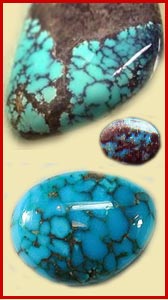
VARISCITE & Variscite Gemstones
Variscite is pale green, dark green, bluish green or shades of yellow to brownish red. Variscite is transparent to translucent. Crystals of Variscite are uncommon but when they are found they are typically pseudohexagonal. Normally Variscite is fine grained massive. It may form nodules, crusts or it can be stalactitic or it can form in veins. The uncommon crystals of Variscite have 1 good and 1 poor cleavage directions. Massive varieties have uneven to splintery fracture. Glassy varieties (more compact) have conchoidal fracture. Variscite is the product of phosphatic waters coming into contact with aluminum bearing rocks, e.g., in caves by the decay of guano. Variscite derived its name from Variscia which is an old name for Vogtland, an area in Germany which provided the first identified specimen. A less known stone in the gem world, but as pretty or prettier then turquoise. Variscite is often mistaken or sold as green turquoise. In recent years this gemstone has been used in all types of jewelry from southwest jewelry to Victorian jewelry.
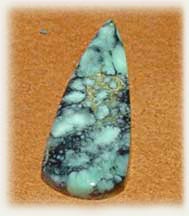
WILD HORSE & Wild Horse Gemstones
Wild Horse is the name given to this stone, whose geological name is magnesite which is a mixture magnesite/hematite. A fairly new stone that was discovered in the mid-90's near the Globe copper mine in the Gila wilderness area of southern Arizona. Some have called it Wild Horse Turquoise but it is NOT turquoise! Since so far, there only seems to be one source for Wild Horse and also because of it's beauty . . . it has retains a high value and is a remarkably popular in Zuni inlay jewelry and Navajo sterling silver jewelry.
WONDERSTONE
Utah Wonderstone – Rhyolite is volcanic. This particular variety was once a very fine volcanic ash. Through pressure and time this ash became rock hard as the colorful chemicals such as iron in the earth seeped through and swirled into a glorious design producing a smooth texture for a soft, desirable cutting material. This wonderstone is only found in the fishlake mountains of Utah near Salina, Utah, Sevier county. Remarkably popular in Zuni inlay jewelry and Navajo sterling silver jewelry.
WAMPUM
Wampum is a quahog shell of deep purple swirls blending into a white background, it is an absolutely beautiful! Wampum is a scarcity because the majority of quahogs are all white and from a ton of shells, only a few shells are large enough and purple enough to be jewelry-grade material. Wampum was used by the Northeastern American Indians since the 17th century as currency. It was a symbol of wealth and power and was used to sanctify marriage vows. This purple and white Quahog Clam Shell is hard to find and harder to work and make into beads or cabs. Purple wampum was worth twice as much as white.
ZOISITE & Zoisite Gemstones
Zoisite, like all epidote minerals, is a structurally complex mineral having both single silicate tetrahedrons, SiO4, and double silicate tetrahedrons, Si2O7. The formula of zoisite could be expressed in a such a way so as to reflect this organization; Ca2AlOAl2(SiO4)(Si2O7)(OH).
Zoisite has been known for nearly two centuries as as a sometimes ornamental stone of limited distribution. Only in 1967 was the blue gemstone variety found in Tanzania. The variety was named Tanzanite and was a surprise to minerologists and gemologists alike in that it had come from a very ungemstone-like mineral. The blue-lavender color of tanzanite is unique and sets it apart from the other gemstones.
Besides tanzanite, zoisite has produced other attractive specimens that are of interest to collectors. A pink variety called thulite is usually massive and used for beads and cabochons. A brilliant green variety is associated with medium grade rubies and is quite popular as an ornamental stone. The red rubies are often distorted and irregularly spread throughout the sea of massive green zoisite. It is one of the most colorful of ornamental stones and competes well with the popular pink tourmaline and lavender lepidolite of California. remarkably popular in Zuni inlay jewelry and Navajo sterling silver jewelry.