
Turquoise Grading and Qualities
Learn how to spot Quality Turquoise & what Turquoise Grades are
What is Quality Turquoise?
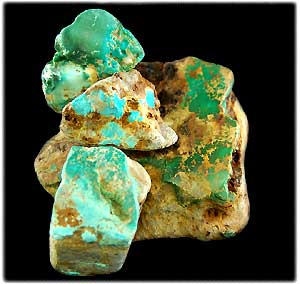 |
Quality Turquoise is obviously determined by the hardness, luster and color of the stone. Having said this, there are many other facters when determining Turquoise Grades. The first is do you have Real Turquoise? What is not so obvious about determining Quality Turquoise as a collector is that Turquoise has two added factors that are different than most gemstones, the color/matrix factor and the location factor. To a gemologist Quality Turquoise is determined by the standards of every other gemstone, and usually they would be looking for solid blue or solid green turquoise with no matrix (host rock) and they would be looking at the hardness and luster (ability to take a polish) to determine if the Turquoise is high Quality Turquoise or low Quality Turquoise. A collector however has the two added qualities to determine. The color.... this is determined by the collector, to say that one color is more valuable than others on todays market would be foolish. In the old days the deeper the blue (naturally), the betterQuality Turquoise you have, an Blue Turquoise was much more valuable. Today, all colors of turquoise are considered Quality Turquoise, infact, some of the odd color such as lime green, yellow, and hard light whitish blue turquoise are some of the most valuable |
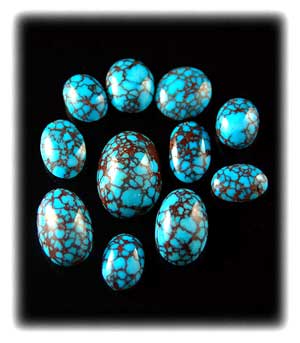
Quality Turquoise. Also, as far as collectors are concerned, SPIDER WEB TURQUOISE IS THE MOST VALUABLE turquoise and of the highest Quality Turquoise.
|
The second factor is that is UNIQUE TO TURQUOISE is the location factor. This is very important to Turquoise Collectors, with American Turquoise being of the greatest value and highest Quality Turquoise in the world. Persian turquoise is also a contender as the highest Quality Turquoise to collectors. Depending on the mine location that a Turquoise stone is from, the value and collectible quality of the turquoise is greatly different. For example, you can have a tight spider web Turquoise cabochon from China, that is super high Quality Turquoise, but is only worth one 50th the price of Nevada's Lander Blue Mine's equal Quality Turquoise. We suggest most people never try to buy the top most collectible turquoise stones, it is very easy to get tricked and there are a lot of dishonest venders in the world, especially when some turquoise demands $1.00/ct and some turquoise demands $300.00/ct !!! ALWAYS BUY FROM A REPUTIBLE DEALER THAT HAS BEEN AROUND FOR MANY YEARS AND WILL GIVE YOU ALL THE INFO YOU NEED TO DETERMINE WHICH STONE OR PEICE OF TURQUOISE JEWLRY YOU WOULD LIKE. We DO NOT recommend buying from roadside stands or dealers offering LOW COST or DISCOUNT Turquoise Jewelry, as REAL Turquoise is very valuable. |
 |
So when trying to determine what is Quality Turquoise try and remember all these factors, but most importantly buy the color and pattern of turquoise YOU like most, that will be the most Quality Turquoise to you and you will enjoy it the rest of your life.
Turquoise Grades And Treatments Done To Turquoise
- High Grade Natural Turquoise: High Grade Natural Turquoise is found in all shades from sky blue to apple green. It is the hardest of Turquoise Grades and takes the best polish. The contrast between the color of turquoise and the color of matrix {or mother rock} enhances the beauty of each stone. Many mines produce distinctive stones whose origin can be identified by an experienced person. High Grade simply put are the best stones that came from a particular mine, the top 10% or less that have the best color, matrix, hardness and are most desireable to the retail public and the collector. These Turquoise Grades are made up of the deep blue Turquoise, desireable off colored and rare colored Turquoise such as lime green Turquoise, "Spider Web Turquoise", "Water Web Turquoise" or "Birdseye Turquoise", the perfect "Robin's Egg" blue Turquoise, Pyrite Included Turquoise, Dendrite Turquoise, Fossil Turquoise and Emerald Green Turquoise. It can be hard for the public to determine the Turquoise grades. High Grade Natural Turquoise is the rarest of all Turquoise Grades. Highgrade Natural Turquoise is rated by AA, AAA and AAAA (which is nearly unobtainable and is less then 1% of the Turquoise on the market and in mines).These top three Turquoise Grades are usually in the 5-7 range on the Moh's Scale of gemstone hardness.
- Natural Turquoise (not High Grade, but standard jewelry grade): Standard natural Turquoise is the next highest of the Turquoise Grades. Standard natural Turquoise is what most mid-range to high end production jewelers use. These Turquoise Grades are rated by AA-, A, B and C. These are the Turquoise Grades that were most common to see during the early years of the Turquoise boom in the 1950s through the 1980s in America. These grades of Natural Turquoise are determined mainly by hardness, matrix pattern and color. These grades of Turquoise usually do not include "Spider Web Turquoise", "Water Web Turquoise" or "Birdseye Turquoise", and the perfect hue of "Robin's Egg" Blue Turquoise. These grades of Natural Turquoise feature standard color saturation to low color saturation, good matrix down to too much matrix or chunky matrix as well as off colored Turquoise or Turquoise that has a grayish hue to it. These Turquoise grades are usually in the 4-5 range of hardness on the Moh's Scale. These Turquoise Grades make up approx. 20 - 30% of the production of most Turquoise mines.
- Low Grade Natural Turquoise: These are the lowest Turquoise Grades and usually end up becoming stabilized turquoise or enhanced turquoise. Low grade turquoise is usually very soft and pale in color. The low Turquoise grades also include ugly colored Turquoise and Turquoise with ugly matrix patterns and too much matrix. The low Turquoise Grades are rated by C, D, and Chaulk Turquoise. This is Turquoise that really should not be put into jewelry without being treated. This is the majority of Turquoise that comes out of most Turquoise mines and is approx. 60% or more of the production of most Turquoise mines. Some Turquoise mines are exceptions to this rule, but it is rare.
- Enhanced Turquoise: The Zachery or Foutz process impregnates turquoise with vaporized quartz. This makes the stone harder, darkens the color and takes a good polish. This process is hard to detect by normal methods because quartz occurs naturally with some turquoise.
- Stabilized or Treated Turquoise: American manufacturers have perfected a process using pressure and heat to fill the microscopic gaps in the stone with plastic resin. When cured the product is a treated stone hard enough to cut and polish. Most nugget and some heishi products are made from real turquoise that has been stabilized. Stabilization allows genuine but lower grade turquoise to be used in Turquoise Jewelry.
- Wax Treated Turquoise: Much of the Ancient Turquoise was wax coated to make it glossy. A lot of Tibetan Turquoise used in Tibetan Turquoise Jewelry is wax finished as well as Egyptian Turquoise. The paraffin treatment deepens and stabilizes the color but only affects the surface.
- Reconstituted: This term describes pulverized turquoise scrap from stone cutting mixed with blue dye and plastic binder. Most products marketed under this name should really by labeled as simulated “block”. Compressed Nugget is a similar product made from larger pieces.
- Block: A mixture of plastic resin and dyes that is produced in loaf sized blocks. We used to call this reconstituted because we were told it was made from ground up turquoise scraps. In reality there is no actual rock of any sort in block turquoise; it is entirely man-made and should be labeled “simulated”. Block is produced in many colors, simulating many different stones and shells. Except for occasional batches of Lapis Block that contain ground up iron pyrite, these are entirely simulated. Block is used heavily for inlay and heishi.
- Dyed Stone Fakes: There are several naturally occurring stones that look similar to turquoise when they are dyed blue. These include Howlite, a white rock with black or gray markings, and Magnite or Magnesite, a chalky white mineral that forms in rough nodules looking faintly like the vegetable cauliflower. Other simulations include glass, plastic, faience ceramic and polymer clay.
- We would like to add that there are some lesser grades of natural turquoise in smaller pieces that are used in small settings and inlay work. These come in varying grades of hardness. The “block turquoise” referred to here is really imitation or plastic and is quite often marketed as the real thing. They can even create a matrix in it. Plastic turquoise or other block stones can melt, fade and become quite less attractive after purchase and wear. Imitation stones are quite often used in machine stamped silver jewelry made overseas and marketed here as Native American jewelry.
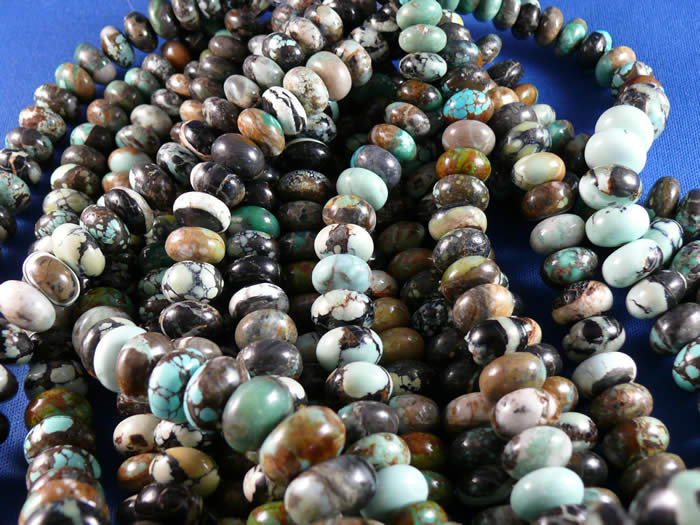
Natural Tortoise Nevada Turquoise & Variscite "Boulder" or "Ribbon" cut roundel beads
Back to the Jewelry Learning Center
Thank you for learning about Turquoise Grades and Quality Turquoise.