When and how the Navajo acquired the art of working metals is unknown
but there are reasons for supposing that it was introduced among them,
or at least more developed and improved upon by them, since the time
they have occupied their present country. According to the sayings
of some of the old silversmiths of the tribe, the art of working silver
was introduced among them by the Mexicans about sixty years ago, or
about the middle of the nineteenth century, when a Navaho blacksmith,
known by his own people as atsidi sani, or the old smith, and by the
Mexicans as Herrero, or the smith, first learned the art from a Mexican
silversmith named Cassilio, who is said to have still been living
in 1872-1873. An old silversmith, beshlagai il'ini altsosigi, or the
slender silversmith, who is still living (1909), and who at one time
was considered one of the best, if not the best silversmith in the
tribe, is said to have originally learned his craft from Mexicans.
The Navaho silversmith, there for, is a comparatively modern product.
Lieut. James H Simpson, who accompanied an expedition into the heart
of the Navaho country in 1849, and who gives in his report good descriptions
of the country and people as they then were, mentions their peach
orchards, farms, herds of ponies, flocks of sheep their beautiful
waterproof blankets. etc., but has nothing to say about their artistic
silverwork. The art then, as it exists today, probably developed since
then, or within the last sixty years. Pg. 271
The Navaho do not mine. Brass for buttons was obtained from the Utes,
and copper for bracelets and ornaments from the Mexicans and traders.
Silver has superseded copper long since, and is purchased in Mexican
coin from the traders. Pg. 64
An Ethnologic Dictionary of the Navajo Language; 1910, The Franciscan
Fathers.
For a time, the ever-ingenious Navajos found a way to secure additional
supplies. Cardboard ration tickets, which were used to obtain food
supplies, were distributed among the Navajos as they passed through
a gate into a corral. They quickly learned to forge the tickets and,
when the government substituted stamped metal ration tickets, those
were also forged. A few Navajos had learned to work metal prior to
their arrival at Bosque Redondo and others apparently learned while
there. These men were undoubtedly responsible for at least some of
the forgeries. It was reported that at one time as many as three thousand
extra tickets were being passed around. The army finally sent to Washington
for elaborate metal disks that could not be copied.
In The Navajo, Ruth Underhill suggests, "When we look for the
origin of silverwork, perhaps this craft [the forgeries], developed
under stress of hunger, may point to an early inspiration." Prior
to the coming of the Spaniards, the Native Americans of the Southwest
had no metal or livestock. The Navajos were undoubtedly envious of
the strange new enemies who rode horses and had guns, bridle bits,
tools, even silver-decorated bridles and saddles. And, even though
many of these items were procured through raids, the Dine' must have
wished for a steady and reliable source. Learning metalsmithing, however,
would have required tools and materials the Navajos did not have,
and the Spaniards were sworn enemies. Contact was far too brief to
allow even the quick-learning Dine' to acquire Spanish skills. At
what time the Navajos actually learned to work metal is debatable.
Some say it happened before the Long Walk, while others differ, but
it is generally accepted that one of the first blacksmiths was Atsidi
Sani (Old Smith), or Herrera Delgadito (Little Slim Ironworker), as
he was known by the Mexicans. Margery Bedinger states in Indian Silver
that "In about 1850 [Atsidi Sani] journeyed south to a Mexican
settlement near Mount Taylor... and persuaded one of the inhabitants,
Nakai Tsosi (Thin Mexican), to teach him how to form the black metal."
If not the first Navajo blacksmith, Atsidi Sani was the most prominent,
and probably the most proficient, of that era. Noted for making knives
and bridle bits, he would teach his craft to many Navajos, including
some of the men at Bosque Redondo. Most of the early metalwork was
utilitarian, but buttons, rings, earrings, belt pieces strung on leather,
and a few bridle ornaments were also made. Multiple bracelets of twisted
metal were often worn on one arm; others, hammered out of copper or
brass, had lightly scratched, simple designs. Navajos had worn silver
ornaments and sported silver bridle decoration for at least fifty
years, but those articles were of Spanish origin, either traded or
stolen from Mexicans, or taken as spoils of war from Utes or Comanches.
In 1853 (eleven years prior to incarceration at Bosque Redondo), Indian
Agent Henry Dodge moved into a newly built stone house near Fort Defiance,
made friends with the Navajos, and eventually married a Navajo woman.
It is also reported that he brought along a blacksmith and a Mexican
silversmith. Many years later, the agent's aged son, Chee Dodge, would
say that "Old Smith [Atsidi Sani] came to the agency to look
on and learned some things." The supposition is that Atsidi Sani
learned or perhaps improved his skills by watching these men, but
whether his skills included silverwork is unknown. Those years were
particularly chaotic; raiding and clashes with other tribes were at
their height. Therefore, the times were not particularly conducive
to learning a new craft, and silver would have been difficult to obtain.
Atsidi Sani's great-nephew, Grey Moustache, is quoted as saying, "It
was not until the Navajo came back [from Bosque Redondo] that he [Atsidi
Sari] learned to make silver jewelry." And Chee Dodge would add
that "The Navajo didn't make any silver of their own while they
were at Fort Sumner. How could they? They were locked up there like
sheep in a corral. They had only a very little silver in those days,
which they bought from the Mexicans." Several newspaper articles
published in New Mexico during those years made claims of Navajo silverwork.
"Navajos at Fort Sumner are skilled enough to make good bridle
bits and other articles of horse equipage in iron and silver,"
one reported. "Amongst the chiefs now on this reservation, many
are dressed in comfortable and even elegant style, in black cloth
and buckskin, well-fitted to their bodies and ornamented with silver
buttons of their own execution and design."
The silver buttons were most assuredly not of Navajo design; they
had been procured from Mexicans for years. Furthermore, this entire
account seems doubtful considering the deplorable state of Navajo
life during exile. One might suspect that the editors, possibly influenced
by corrupt politicians who were noted for their greed-and-graft mentality,
were trying to make living conditions appear much better than they
were. Historic photographs show the Bosque Redondo Navajos poorly
dressed in cotton clothing or wrapped in blankets against the bitter
cold. It is unlikely that even "the chiefs" mentioned in
the newspaper article would have dressed as described. If any did,
they must have been the exception, and any silver ornaments they possessed
were probably trade goods. It seems much more probable that the Navajos
learned to work silver soon after they resettled in their homeland.
Atsidi Sari is generally considered the founder of the silver craft,
but whether he learned it from the same Mexican who taught him metalwork
or from another Mexican friend is unconfirmed. However, his first
students were his four sons who, in turn, taught others.
With peaceful conditions, Mexican smiths began traveling onto the
reservation to trade their silver for Navajo livestock. As the silversmith
fashioned a piece, the Navajo who ordered it would certainly have
observed and perhaps even assisted by working the bellows. Considering
their propensity for acquiring new skills easily, the Navajos must
have recognized this as an excellent opportunity to learn to craft
their own silver ornaments. It has been recorded that they were casting
jewelry as early as 1870. Silver coins, acquired from soldiers at
Fort Defiance and Fort Wingate, were melted down, then poured into
hand-carved molds to create a particular design or a simple ingot,
which was then cooled, hammered into a thin sheet of silver, and trimmed
to the proper shape. The learning process, however, was still gaining
momentum. In 1884 John Lorenzo Hubbell (the much-admired Don Lorenzo
of Hubbell Trading Post at Ganado) and his partner, C. N. Cotton,
hired Mexican smiths to teach silversmithing to the Navajos, and began
furnishing some of the coins used to fashion the silver ornaments.
The first Navajo silverwork was rather crude and quite heavy, but
it showed a lot of promise. Designs were symmetrical even though smiths
had no precision implements; in fact, they had few tools of any kind,
often just a hammer, some files, and scissors or metal snips.
Washington Matthews, a young army surgeon from Fort Wingate and the
most noted Navajo authority of the 1880s, recorded the tools and techniques
used by Navajo smiths. For anvils they acquired pieces of train rail,
kingpins from wagons, any old pieces of iron large enough, hard stones,
or tree stumps. Forges were made of mud or sandstone, the bellows
from goatskin bags, and crucibles from anything that worked stones
with small hollows, tumbler-sized pottery pieces made especially for
that purpose, or iron pipes with one end flattened, turned up, and
sealed. A semicircle or V-shaped groove was sometimes cut into anvils
for shaping bracelets; the first molds were made from baked clay and
discarded after a time. Later molds were carved from iron, wood, or
soft sandstone, which was greased with mutton tallow to prevent sticking.
Some of the first silver items made by Navajo smiths were the buttons
they had previously obtained from Mexicans. Men's trousers, jackets,
leather pouches, bridles, saddles, gun scabbards, ketohs, or bow guards,
the wide leather bands worn on the left wrist to protect from the
bowstring's recoil. and belts were adorned with these silver ornaments.
They also decorated the moccasins and leggings of both sexes, and
women's blouses had rows of them at the neck, across the shoulder,
down the front, and running the length of both sleeves.
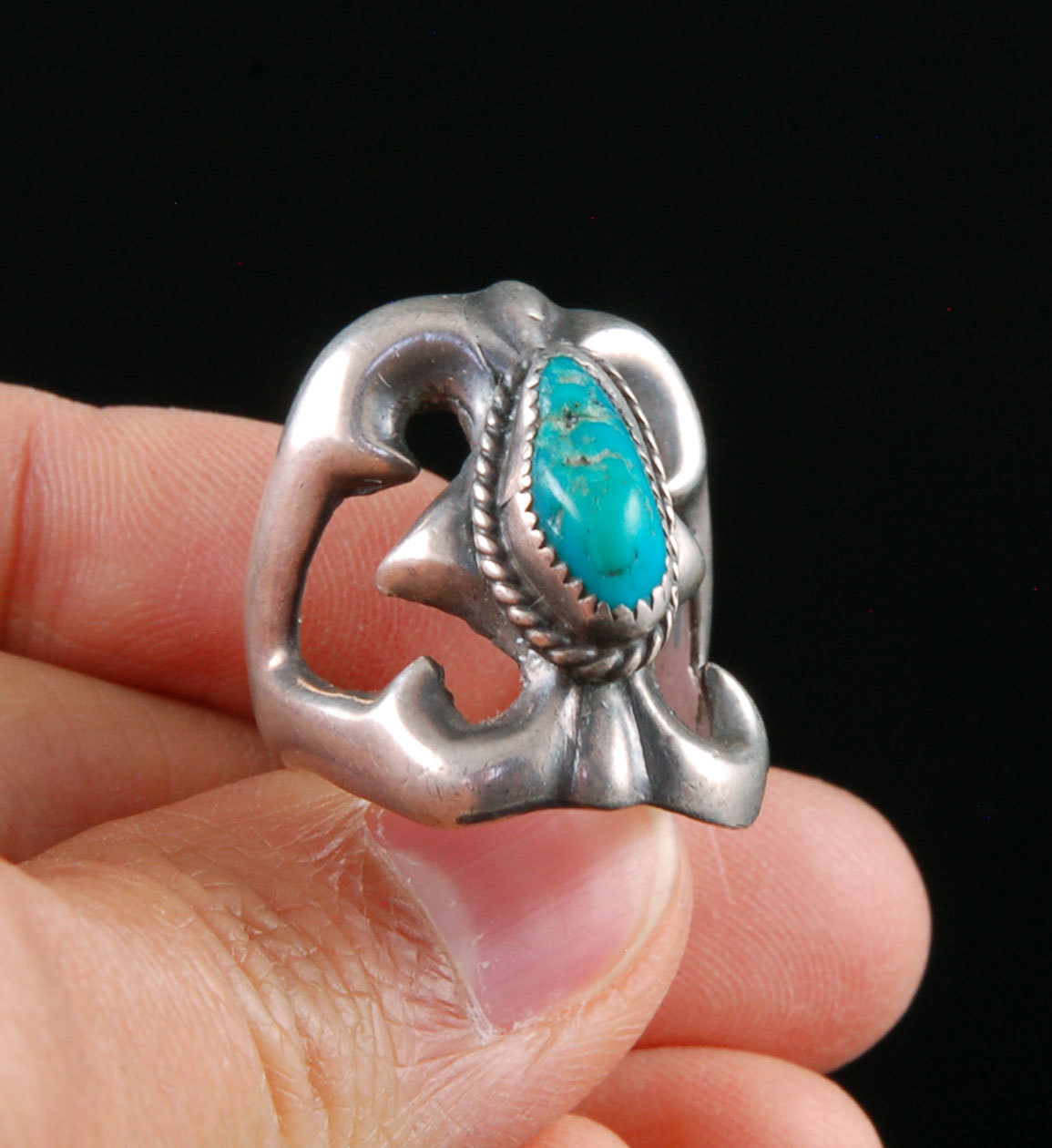
Many bracelets were nothing more than narrow bands with notches cut
on either side; others were made of twisted wire or plain silver with
simple designs scratched in with a file. Conchas for belts were decorated
with scalloped edges, punched holes, and incised and stamped designs.
Rings were simple decorated hands of silver; earrings were large loops
that passed through pierced ears. Silver replaced the tin decorations
on ketohs. Small silver canteen-shaped containers for carrying tobacco
were copied from rawhide ones carried by Mexicans. The headbands of
bridles were covered with wide strips of silver that almost concealed
the leather. Normally, a silver concha was added on either side, and
a crescent-shaped ornament called a naja hung from the forehead strap.
Najas, adapted from those used by the Spaniards, were worn on bead
necklaces as well, and were often interchangeable with those on bridles.
Matthews also recorded the bead-making process which began around
1870. By this time, the smiths were apparently turning from U.S. coins
to pesos for their silver; Matthews mentions that Mexican silver dollars
were used to form the beads. A peso was pounded into the desired thickness;
then a disk large enough to make half a bead was cut out with scissors.
It was trimmed and used as a pattern for the others. Half-circles
were formed with a mold and die; the pieces were strung on a stout
wire in pairs forming full circles and fastened tightly together.
A mixture of borax, saliva, and silver was applied to the seams of
all the beads; they were put into the fire and all soldered at one
time. After cooling, the beads were blanched, filed, and polished.
Bead necklaces had become very popular by the 1900s. According to
G. W. James in Indians of the Painted Desert Region, "scarcely
a man or woman of any standing in the tribe does not possess a home-manufactured
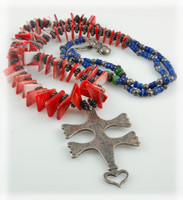
necklace of silver beads." The "squash blossom" necklace
was probably introduced around the turn of the century. It was not
mentioned by Matthews in the 1880s, but was included in the Franciscan
Father's Ethnologic Dictionary of 1910: "When arranged upon a
string or thong, each necklace contains from fifty to sixty the finer,
smaller specimens often number as many as one hundred beads. Usually
they have a large crescent-shaped pendant in the front center, and
in the lower half of the strand small silver crosses, and other flowerlike
ornaments are strung after every second or third bead. Necklaces of
this kind are very much prized by the Navajo and are certainly very
ornamental." The most accepted theory about the squash blossom
design is that it symbolizes the Mexican pomegranate. In A Brief History
of Navajo Silversmithing, Arthur Woodward wrote: "It is my contention
that all of these beads were originally Spanish-American trouser and
jacket ornaments. . . . [The pomegranate] has been a favorite Spanish
decorative motif for centuries . . . it seems foolish to look farther
afield for prototypes of this highly popular necklace element. If
one were to remove these buttons or cape ornaments from the original
garments and string them, the result would be a fine 'old' Navajo
necklace." The ornament was quite possibly misnamed by a trader
who thought it resembled a squash blossom.
The first decorations on silver were merely scratched in with a file.
Later, a stronger tool was used to cut deeper lines. The technique
of "punching" silver was adapted from the Mexican tooling
of leather. Any sharp-pointed piece of iron was used as a tool to
punch dots into the silver. The first stamps were made by cutting
a piece of pipe in half to make the imprint of a semicircle. Don Lorenzo
brought steel dies, or stamps, to Hubbell Trading Post later, but
many smiths still made their own. The years from 1880 to 1900 have
been called the Classic Period in Navajo jewelry. The time of learning
was over, but the tourists had not yet entered the scene. There were
numerous smiths on the reservation, each making the items he wished
to his own satisfaction. They used curved figures and lines in their
designs, and most used carved dies which they made themselves. Many
new, and much-improved, tools were available, such as tongs, pliers,
cold chisels, punches, awls, vices, and dies. Since the use of U.S.
coins had been declared illegal and the Mexicans had stopped exportation
of pesos, most of the smiths fashioned their silver ornaments from
one-ounce squares of coin silver.
Silver jewelry had become a status symbol among the Navajos, the mark
of wealth and prestige. The "pawn system" allowed them to
pawn their jewelry to traders in exchange for food and other necessities.
The jewelry was redeemed when the owner had the money, usually from
selling a rug or the wool from newly sheared sheep. In the meantime,
traders often allowed the owner to borrow the jewelry for a ceremony
or a fair, then return it the next day. Southwestern tribes had used
shell and turquoise beads in necklaces and earrings for centuries,
and the early Navajos wore these ornaments as well as turquoise nugget
earrings. The nugget necklaces so popular among the Navajos probably
evolved through the years. As turquoise became more available, it
gradually replaced much of the shell. Adding turquoise to silverwork
was not a common practice until around 1900. Even then, one large
stone was usually set into each classically simple piece. Other stones,
used to a lesser extent, included garnet, peridot, opal, coral, smoky
topaz, jasper, carnelian, chalcedony, agate, malachite, and jet, to
name a few. None ever enjoyed the popularity of turquoise. In the
early 1900s, the winds of change blew in with the coming of the railroad
and the Fred Harvey Company, which established accommodations along
the route. Tourism was introduced to Indian country, and tourists
wanted silver jewelry. However, most of them neither knew nor cared
anything about quality; they wanted inexpensive pieces adorned with
garish designs, and shopkeepers were all too willing to please. Items
made strictly for tourists began appearing: ashtrays, watch bracelets,
letter openers, cigarette holders, and utensils.
Larger companies began mass-producing "Indian" jewelry;
smaller shops hired both non-Indians and Indians from various tribes
to machine-stamp cheap, tinny silver with designs such as lightning,
clouds, arrows, Indian heads, snakes, owls, swastikas, and thunderbirds,
the last merely a figment of someone's imagination. Lists of what
these figures supposedly symbolized were given to tourists. At that
time, designs on authentic, handcrafted Indian jewelry were simply
decorative. To quote Carl Rosnek in Skystone and Silver: "A great
deal of nonsense was written or rumored concerning the 'meaning' of
these symbols-when in fact, with few exceptions, they had none for
the Indians." Much of the tourist jewelry was made of nickel
and decorated with small imitation-turquoise stones. Many of these
items, sometimes referred to as "Route 66" jewelry because
of the proliferation of shops selling it along that highway, were
stamped "nickel silver." By 1937, laws were passed stating
that only Indian-made jewelry could be labeled as such, but circumvention
became a favorite pastime. In 1940, the Japanese even went so far
as to name a town "Reservation," so they could "legitimately"
stamp Reservation Made onto manufactured jewelry.
In an effort to slow down the mass production of cheap imitation Indian
jewelry made in sweatshops (as they were commonly called), the government
ordered that only handmade jewelry could be sold at National Parks
and Monuments, and some schools began teaching silversmithing. However,
these were troubled times and, with war looming on the horizon, the
government had other concerns. In 1941 it did form the Navajo Arts
and Crafts Guild to emphasize quality work and encourage the casting
of silver; consequently, the skills of many artists improved. The
project had to be dropped during World War II, but the Navajo Tribe
was allowed to take it over. Despite the problems facing the world
and the degradation of their craft during the early 1900s, there were
many smiths who never lessened their standards. Superb craftsmen continued
to set high-grade stones in quality silver, and some excellent jewelry
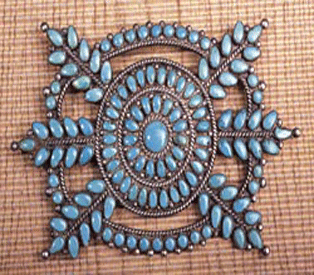
of that period is considered classic. The use of turquoise had increased
through the years, and a few jewelers began adopting the Zuni style
of setting multiple stones close together in silver. A larger piece
of turquoise was surrounded by small stones, thus forming a cluster.
This "cluster style" was a change for Navajo silversmiths,
but the Navajos have always accepted change-when it benefited them.
Experimenting with new techniques and styles was a change they welcomed.
Pgs. 9-28
Navajo Jewelry, A legacy of Silver and Stone; 1995, Lois Essary Jacka:
Jerry Jacka.
The famous Navajo silverwork began in these hard years of reconstruction.
It was a move made on the Indians' own initiative and, at first, without
help from school or agent. For fifty years or so the Navajos had been
wearing silver jewelry and bridle ornaments stolen or traded in Mexico.
Why should they bother to make such things themselves? They were too
busy with war and sheep raising. However, one medicine man called
Etsidi Sani, or Old Smith, had at least been interested in ironwork.
He had got a "Mexican" friend, which means New Mexican,
to teach him how to make iron ornaments for bridles. Some have said
he made silver as well as iron, but Old Smith's descendants are sure
that the Navajos knew nothing about silverwork before going to Fort
Sumner. At the fort, Old Smith had no chance to practice his art-unless,
indeed, it was he who counterfeited those identification tags. "How
could the Navajo work silver at Fort Sumner!" exclaimed their
late chairman Chee Dodge. "They were locked up there just like
sheep in a corral!" But when they returned to a poverty-stricken
land, that was a different matter. Old Smith went back to his Mexican
friend and, say his descendants, learned how to forge and hammer silver.
He taught his four sons, using a forge made of baked mud, a bellows
of goat skin, and tools out of any pieces of scrap iron begged or
filched from the whites. Eagerly the Navajos seized this new means
of trade and livelihood. The Zunis still tell how Ugly Smith, one
of Old Smith's sons, came to their village in 1872. He came as a poor
man, with nothing but his tools and the horse he rode. He stayed a
year, teaching the Zunis to make bridle ornaments, belts, and bow
guards. When he left, he was driving a herd of horses and sheep ahead
of him. That was a bit later in Navajo history. Pgs. 157-158
The Navajos; 1956, Ruth M. Underhill.
Silversmithing was learned even more recently. Woodward's data show
that the Navahos started to work silver at some time between 1853
and 1858. Techniques were probably learned from whites, either directly
from Mexicans or indirectly through other Indian tribes. Much about
metal-working may have been learned from the smiths at Fort Sumner
during the captivity in the sixties. Of design, Woodward says:
The ancestry of Navaho silver ornament forms has its roots in the
silver trade jewelry distributed to the tribes east of the Mississippi
River after 1750, and in the Mexican-Spanish costume ornaments and
bridle trappings of the late eighteenth and early nineteenth centuries.
The silver distributed to eastern Indians goes back to the traditions
of the great English smiths. Thus modern Navaho silver blends English
and colonial traditions with Spanish and (ultimately) Arabic. This
explains why the solid, simple pieces in the classical Navaho tradition
often remind connoisseurs of antique English silver. Pgs. 26-27
The Navaho; 1946, Clyde Kluckhohn and Dorothea Leighton.
Navajo silverwork has also been the subject of substantial scholarly
research. Readers interested in the various forms and stylistic changes
of Navajo jewelry are referred to the excellent studies by Margery
Bedinger (1973), John Adair (1944), and Arthur Woodward (1971). Our
present study is concerned with the economic implications of and technological
changes in Navajo silversmithing. The Navajos were wearing silver
jewelry obtained from the Spaniards by the late eighteenth century,
and learned silversmithing from them in about the mid-nineteenth century.
Although many scholars have contended that the Navajos did not begin
working in silver until after Bosque Redondo it seems likely that
they were learning the rudiments of the trade in the previous decade.
However, the evolution of silversmithing as an economically important
craft did not take place until after 1868. In 1869, Edward Palmer,
who led several expeditions from the Peabody Museum to the Southwest
during the 1870s, wrote that the Navajos were making silver buttons
from Spanish and Mexican one real coins. According to Palmer, the
buttons were used as money. A one real coin was worth 12 1/2 or eight
to the dollar, and the buttons had the same value. Lack of proper
tools limited the quality and variety of items produced by early Navajo
silversmiths. In 1871 the agency requested and presumably issued a
small number of anvils, vises, hammers, files, file saws, and bellows
to help Navajo blacksmiths, who usually worked as silversmiths as
well.
During the 1870s, the quality of Navajo silverwork improved as smiths
acquired a wider variety of tools from traders and learned to make
tools themselves. Matthews noted in the early 1880s that Navajo smiths
purchased scissors, iron pliers, hammers, awls, emery paper, fine
files, and borax for soldering from local traders. They had also learned
to make goatskin bellows, anvils, dies and bolts, sandstone molds
for casting, tongs, and brass blowpipes.
As their equipment improved, the silversmiths could produce a greater
variety of items. By the early 1800s, they were making buttons, rosettes,
bracelets, bridle ornaments, and concha belts. Three or four of the
smiths were fashioning canteen-shaped tobacco cases. About 1880, some
of the smiths in the Ganado area started to make jewelry with turquoise
sets. Silversmithing flourished during the 1880s, when the Navajos
prospered and began investing their wealth in silver jewelry. In 1880,
when Navajo employees of the agency were asking for their pay in Mexican
coins Manuelito decided to make bridles out of silver money. Navajo
silversmiths were finding a ready market for their work among their
own tribesmen, and a profitable trade in silver jewelry was evolving
with local whites and members of other tribes.
The development of the pawn system during the 1880s further encouraged
silversmithing. Silver ornaments, no matter what kind, could be pawned
to traders in exchange for other goods. The pawn system expanded the
function of silver jewelry from personal adornment to "savings"
which could be used during times of economic crisis. Bedinger thought
that silversmithing probably started in the Ganado area, and noted
that most of the "pioneer" Navajo silversmiths lived within
twenty-five to forty miles of Ganado. The number of smiths rapidly
increased during this period, and by 1900 silversmiths lived throughout
Navajo country Nevertheless, in terms of technique, design, and skill,
the Ganado smiths continued to excel.
A History of the Navajos, The Reservation Years; 1986, Garrick Bailey
and Roberta Glenn Bailey.
The masculine counterpart of the squaw's art of rug weaving is silversmithing.
In recent years, however, the women have been taking up silversmithing,
and it is estimated that today there are nearly a hundred women silversmiths
on the reservation. Since there are no silver mines on the reservation,
the Navajo had to obtain his metal from outside. He used to melt down
dollars, but he is now able to buy from the traders squares of silver
known locally as "slugs." The Navajo silversmith is a true
artist who will work incessantly for many hours and even without food
until he has finished his piece of jewelry. Though he borrowed the
craft from the Spaniards only about eighty years ago, he has developed
it to a high degree of perfection, despite a lack of proper tools.
His rings, belt buckles, bracelets, and necklaces, frequently set
with native turquoise and adorned with die-work, are worn by both
Navajo men and women. They are also treasured by the white people
of our country and visitors from abroad. Navajo bracelets have no
clasps. Each bracelet has a small gap through which one's wrist slips.
If the gap is too big, the ends can be pressed together after the
bracelet is on. An expert can slip over his wrist a bracelet even
with a very small gap by pressing one end into the depression between
the two forearm bones about two inches above the wrist joint.
At one time, only the Navajo men wore silver earrings. The women had
to be satisfied with a loop of turquoise beads. The men's earrings
were so tremendous that when they rode a horse they had to tie them
to the back of their necks to avoid excruciating pain. Most of the
silver ornaments sold in stores or to tourists are made by Navajo
men who practice their craft in the railroad towns or their vicinity.
The Navajo of the interior works with silver for his own pleasure.
He does not have the tools of his commercialized urban brother - the
anvil, blow torch, solder, compass, steel stamps, vise, nipper, pliers.
For an anvil, he used a hard stone or a piece of iron from a plow
or wagon. Instead of a blow torch, he has mud and sandstone forge
with a hole in its bowl shaped bottom through which air is pumped
from a goatskin bellows to keep the fire smoldering. His smelting
fuel is charcoal made from juniper logs. His crucible in which he
melts his silver is made of poor clay that is porous and brittle.
He greases his sandstone molds before he pours his molten silver into
them. To solder, he directs the flame from a wick through a piece
of tubing to the desired point on his fine piece of silver. His solder
consists of borax, saliva, and silverdust. When he has finished his
work of art, which by now is tarnished from flame and handling, he
dips it into a concoction of "rocksalt" in boiling water.
He does this before ornamenting it with turquoise, so that he will
not damage the precious stone.
Despite the simplicity and crudeness of his equipment, the Navajo
silversmith of the interior is able to produce round hollow silver
beads and many other ornaments of unsurpassed quality. His hollow
beads are made by soldering together two semispherical pieces of silver
which have been hammered on hard wood marked with indentations of
various sizes and designs. The solid or raindrop bead is made without
the use of a mold. He blows air through a piece of tubing on a bit
of melted silver to give it the shape of a raindrop. A more recent
method is to take a small snip of silver and heat it over a small
indentation in charred wood, or on the so-called sandstone, which
actually is pumaceous tuff. The snip of silver turns into a small
ball. By this technique dozens of balls may be made at the same time.
His engraving on a flat silver ornament is done with the aid of sharply
pointed knives, wires, and chisels. The commercial jewelry has a lot
of punched or stamped silver in it, but the Navajo prefers for himself
the simpler designs.
It is really astonishing what a stolid, uninspired-looking Navajo
can do with a few simple tools. My wife wanted a silver compact made
for her like the one she already had a machine-made object, the product
of precision tools. To our amazement though it took him a whole day
because of the primitive nature of his tools before our eyes he reproduced
the whole thing in every detail, including the old-style trunk hinges,
by melting chunks of crude silver and pounding it into the desired
shapes. In addition he decorated it with Navajo designs and turquoise.
The compact is a piece of art far superior in value and beauty to
the original from which it was copied.
The white purchasers expect all sorts of symbolism in their designs,
so the Navajos give it to them. some Navajo designs are natural developments
from pieces of silver that have come into their possession. For example,
tubular beads were first made from silver buttons taken from Spanish
soldiers whom they had killed in battle. And the pronged pieces in
the beautiful so-called squash blossom necklace are the buttons which
were sewed along the outside seams, from hip to ankle, of Spanish
army officers' pants. They really represent the pomegranate blossom.
The horseshoe-like piece hanging in the center of this necklace is
taken from a device meaning "Godspeed" that was used on
old Spanish bridles. It rested on the horse's forehead, ending in
two palms turned inward. The Navajo borrowed the design and replaced
the hands with two turquoise stones.
The Navajo began combining turquoise with silver, it is said, some
fifty years ago. It is a poor Navajo who has no turquoise. Turquoise
us found in Turquoise Mountain in Arizona; Los Carrillos, New Mexico;
Sand Bernardino County, California; and Nye County, Nevada. It is
also imported from Persia and Egypt. Turquoise is a basic phosphate
of copper and aluminum. The copper gives it its bluish tone. The color
of turquoise varies from greenish-gray, yellowish-green, apple-green,
and greenish-blue to sky-blue, the latter being the most valuable.
Its color fades in time and is destroyed by heat. Perspiration also
affects it. A restoration of its natural color can be effected by
treating it with ammonium. Bone and fossil turquoise, known as odontolite,
is not true turquoise. It consists of fossil bones or teeth, colored
blue by vivionite, a hydrated iron phosphate. Ammonia will not improve
the color of odontolite. Pgs. 167-170
Navajos, Gods, Tom-toms; By S.H. Babington, 1950.
Western
Silver Information | Glossary
of Jewelry Terms

Turquoise Information:
Turquoise
Mine List | Grades
& Quality | Healing Beliefs
| Physical Properties | Spiritual
Beliefs | Symbolism | USGS
History | Other Gemstones

Shop
on our Ebay Store
Visit Our Catalog of our jewelry by clicking the
links below:
Belt Buckles
| Bracelets | Earrings
| Necklaces | Pendants
| Pins | Rings