Persian or Iranian Turquoise
Persian or Iranian Turquoise
Iranian or Persian Turquoise
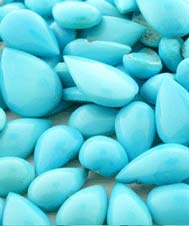 |
Persian Turquoise comes from a number of mines in modern day Iran. The stones from all mines show a great color variation. Many mines were worked around Nishapur, 225 miles east of the southern end of the Caspian Sea, close to old caravan routes. Persian Turquoise has been highly coveted in the middle east for centuries. Firm evidence exists that Persian Turquoise these mines were heavily worked beginning in the 10th century, but there is also evidence that some of the mines near the surface may have been exploited as early as 2100 B.C. Persian Turquoise has been used in jewelry for thousands of years and will most likely contiunue to be used for thousand of years more. Persian Turquoise mines in Iran mostly belong to Neishabour near Mashhad, there is more than 100 caves for excavation. Iran has also has a mine in Damghan (Bagho Mine)and a newly opened mine in Kerman (it is too new and selling from this mine is not permitted yet, but Iranians can find some in the market) which has good quality. |
 |
|
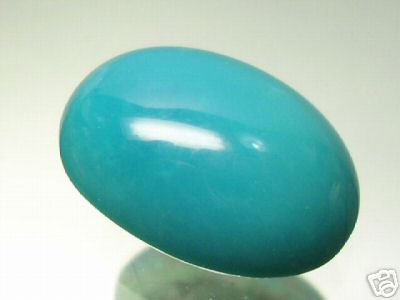
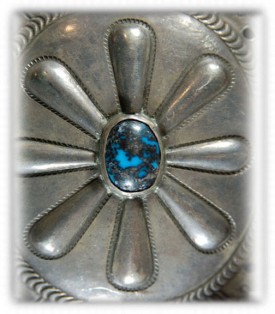
The Persians divided Turquoise into three classes. Fine ring stones were called Anqushtari. Persian Turquoise stones of intermediate quality were called Barkhaneh. Persian Turquoise Stones that were pale, greenish, or with spots from the matrix were called Arabi. Traditionally, brilliant blue stones with no matrix were preferred in the Middle East. You could say this was the original Sleeping Beauty Turquoise. Today, Persian turquoise in a variety of shades and matrices can be found in jewelry and appreciated for its classic beauty. These stones adorn some wonderful men's turquoise jewelry such as mens Turquoise bracelets, mens Turquoise pendants, mens Turquoise rings, and men's Turquoise necklaces. Throughout the centuries, the intense sky-blue Iranian turquoise, known as “Persian turquoise,” has been the most sought after. This is a clear, even blue color with no evidence of green, nor any signs of black veins. As recently as the ‘70s, top-quality turquoise was fetching prices of $2,000 for a 15x20mm piece. Hard to believe? Did you know that no English gentleman of the 17th century was regarded as well dressed or well adorned unless he wore jewelry of turquoise? This stone was so highly valued that all 79 of the emeralds in the crown that Napoleon I gave his consort Empress Marie Louise were replaced with Persian Turquoise cabochons. |
 |
There are many more Persian Turquoise mines or claims in Iran than listed below, but here are a few known and varified Persian Turquoise mines:
- Abo Ishaghi : This old cave was closed 50 years ago, It is said that the oldest cave is this cave, it had the highest quality of Turquoise that was extra hard which allowed cutters to create special shapes with sharp points. This cut is also known as Abo Ishaghi. Some people also call it Abdo Al'Razaqi.
- Rokni - This mine had good quality Turquoise and was excavated from under ground to the top of the mountain
- Khak Ghermez - This mine is known for the "Robin's Egg Blue" Turquoise and a mid blue color Turquoise that is cut to exclude any matrix. This is probably the most commonly known Persian Turquoise world wide.
-
Chah (which means shaft in english): It is active now workplace is in depth of 80M, the workplace contains water and they have to pump it out every time they work, it is very difficult for work, but the quality is the best at the moment. It has very hard and dense Turquoise, mostly in deep blue tone. There are some cut stones in the market only few dealers have them, (they are thousands of dollars for each stone). they are mostly flawless and very nice luster and take a great polish.
-
Ghare Sabz (which means green cave in english because there are trees around it, not because the color of the Turquoise): they have deep blue color Turquoise, but mostly veins of Turquoise, the hardness is also very good. This cave is still in production..
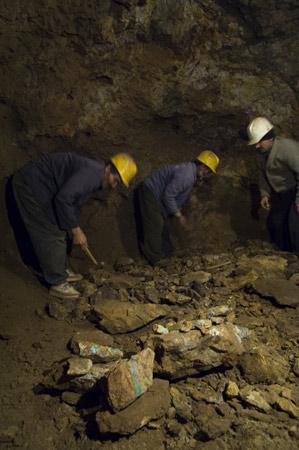
Persian Turquoise Mine Photos
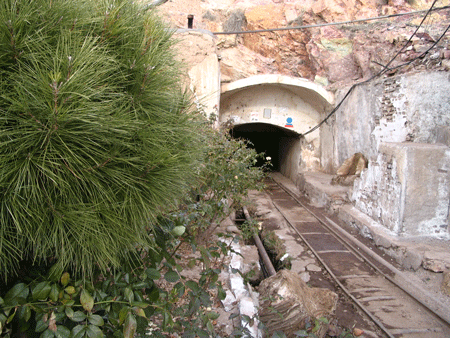
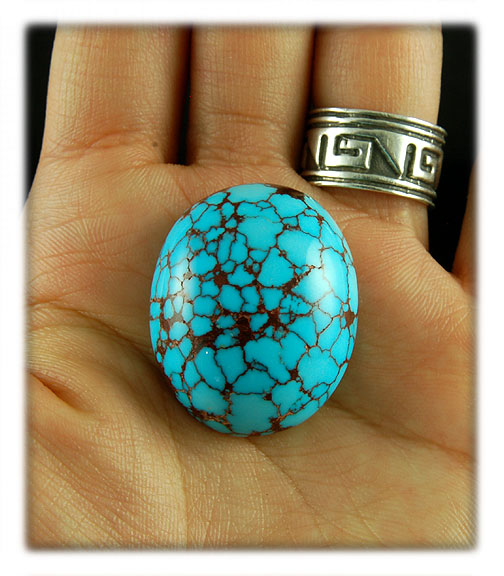
Persian Turquoise is known for its clearity and color which is often refered to as "Robin's Egg" blue. Having said this, there is some very beautiful spider web Persian Turquoise. The spider web matrix Persian Turquoise is some of our favorite Turquoise.
Persian Turquoise Videos:
I will continue to add to this list and eventually attempt to have a listing of all turquoise mines that have existed in Iran. I need your help! If you know of another legitimate mining operation or old mine claim in Iran, contact me at: durangodillon@gmail.com
Back to the Jewelry Learning Center
Thank you for reading about Persian Turquoise and learning more about Persian Turquoise.