ARIZONA TURQUOISE WE USE:
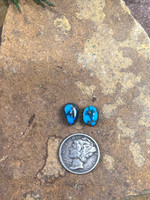
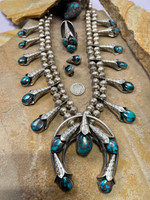
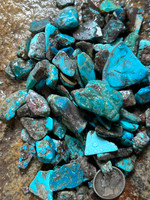
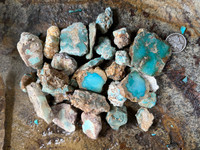
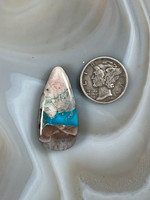
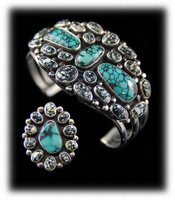
Bisbee Turquoise
The Bisbee mine "the Lavender Pit", near Bisbee, Arizona, is
one of the more famous of the American mines because Bisbee turquoise was
one of the first put onto the market. The Arizona turquoise mine is part of
the Bisbee copper mine (The Copper Queen), the main operation of the site.
Bisbee turquoise has developed a reputation as a hard, finely webbed or dendrite,
high blue stone, known for its "chocolate brown" matrix. Bisbee
Turquoise also comes in a beautiful dark green color. Most of this turquoise
has already been mined and what is left is in limbo due to circumstances with
the copper mining in the open pit, it is one of the most highly collected
stones. Most jewelry being made with this stone today is being made via the
orders of the current owners of the mine, the rest (such as ours, which is
all hand cut and mounted in silver jewelry by Durango Silver Co.) is found
through old "stashes" or collections that have been obtained. Bisbee
Turquoise Jewelry is some of the most desired jewelry on the market.
More Bisbee Information | More Turquoise Information | Arizona Mine List | Silver Jewelry Information
Turquoise Mountain and "Birdseye"
Turquoise Mountain and "Birdseye" turquoise come from the same mine
in northwestern Arizona near the Kingman mine. The mine was closed in the
1980s. It is light to high blue, with both webbed and non-webbed matrix. "Birdseye"
describes stones from this mine that show areas of light blue circled with
dark blue matrix, resembling the eye of a bird. It is a beautiful addition
to one's collection. If you have a collection of turquoise jewelry you definitely
need this!!
More Turquoise Mtn. Information | More Turquoise Information | Arizona Mine List | Silver Jewelry Information
Sleeping Beauty Turquoise
The Sleeping Beauty mine is located near Globe, Arizona. Its turquoise is
noted for its solid, light blue color with no matrix. Sleeping Beauty turquoise
is the favorite of the Zuni Pueblo silversmiths for use in petit point, needlepoint,
and inlay jewelry. This mine is one of the largest in North America and is
still operating. Another staple of today turquoise jewelry industry. Most
of the robin's egg blue turquoise you see today is sleeping beauty turquoise.
More Turquoise Information | Arizona Mine List | Silver Jewelry Information
Morenci Turquoise
Morenci Turquoise is mined in southeastern Arizona. It is high to light blue
in color. Morenci has an unusual matrix of irregular black pyrite that, when
polished, often looks like silver. Morenci turquoise is well known because
it was one of the first American turquoises to come on the market. It is very
difficult to obtain now because the mine is depleted. It is a collectible
turquoise. Wearing a piece of turquoise jewelry featuring Morenci turquoise
puts you in the collectors circle fast.
More
Turquoise Information | Arizona
Mine List | Silver
Jewelry Information
Colorado Turquoise We Use
Manassa (King's Mine or Lickskillet Mine)
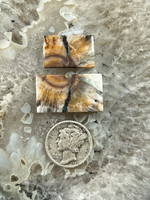
Manassa turquoise is mined at Manassa in south central Colorado.
It is known for its blue-green to green color with a golden or brown, non-webbed
matrix. The Manassa mine is still in production, and owned by the King family,
thus the alternate name sometimes used for this turquoise. The Manassa mine
used to be call the Lickskillet Turquoise Mine in the old days. This stone
is one of our favorite Turquoise varieties! Although, King's Manassa turquoise
is gorgeous in turquoise jewelry with sterling silver, the beautiful green
color is VERY striking, excellent when used in gold.
More Manassa Turquoise Info | More Turquoise Info | Colorado Mine List | Silver Jewelry Info
Villa Grove
Villa Grove Turquoise was some of the finest Turquoise to ever come out of
American soil. The Villa Grove Mine in Colorado is currently covered by a
small mountain lake created by runoff and a natural spring, therefore is not
being mine currently. The Mine was last owned by George Musik and before that
by Menless Winfield. The turquoise is vivid deep blue, the only other turquoise
we have seen with the highly coveted Bisbee Blue coloration or an absolutely
stunning electric blue, the difference is the matrix is gold rather then brownish
red, and usually a fine spider web or dendrites. The high-grade Villa Grove
Turquoise in our opinion is incomparable, definitely the most beautiful Turquoise
we have ever seen including Bisbee, and Lander Blue! The blue in the high-grade
is so blue that a few cabs will turn a whole wall blue! This stone is very
rare these days, especially the high-grade. Turquoise jewelry should thank
Villa Grove for being around to make it greater!
More Turquoise Info | Colorado Mine List | Silver Jewelry Info
Nevada Turquoise We Use
Blue Diamond Turquoise Mine
A Rare deep blue Turquoise producing mine in Nevada, Blue Diamond was mined
mostly in the 60s and 70s. You don't see much of this great stuff around anymore.
It is dark blue with a black matrix of dendrites and triangle shaped black
chert. The blue a lot of times is a swirling of two dark blues,.. it is stunning
This is a classic American Turquoise Look.
More Turquoise Information | Nevada Mine List | Silver Jewelry Information
Blue Gem Turquoise Mines
The Blue Gem mine near Battle Mountain, Nevada produced a great variety of
turquoise, from intense blues to deep green combinations with a hard, irregularly
distributed matrix. While there are other mines in Nevada of the same name,
the Battle Mountain Blue Gem mine& the Tonapah Blue Gem Mine, which began
production in 1934 and is now closed, yielded the most valuable Blue Gem turquoise
because of its rich color and its hardness. It is greatly desired by collectors.
One of our favorites! This is an all time favorite and classic American Turquoise.
Blue Gem Information | More Turquoise Information | Nevada Mine List | Silver Jewelry Information
Blue Wind Turquoise Mine
Probably one of the finest, most unknown Nevada spider webs ever. There was
very little of This stone to come out, we only had it offered to us once,
even though we offered to buy all that they could produce! Deep blue with
a black spider web. We consider This spider web second only to Lander Blue!
This was another of Cutler Edgars mines. Wonderful in gold turquoise jewelry.
WOW killer spider web American Turquoise.
More Turquoise Information | Nevada Mine List | Silver Jewelry Information
Broken Arrow Variscite and Turquoise Mine
The Broken Arrow Mine is located in the Candelaria Mining District of
Nevada outside of Mina. The Broken Arrow claims belong to the Otteson's. What
has come out of the Broken Arrow thus far is a blue and emerald green spider
web and clear Turquoise and Varascite, some call Variquoise. The emerald green
variscite is absolutely stunning, it looks like forest green emerald or jade.
Some of the finest variscite we have ever seen. Some of the turquoise they
are pulling out looks like old fox, the good stuff. Look at this gorgeous
turquoise jewelry!!
More Turquoise Information | Nevada Mine List | Silver Jewelry Information
Royston Turquoise Mines
Bunker Hill Mine - Oscar Wehrend - Royal Blue
Royston is a district in Nevada consisting of three turquoise mines: Bunker Hill, Oscar Wehrend, and the main producer, Royal Blue. Royston is known for its beautiful colors ranging from deep green to rich, light blues set off by a heavy brown matrix. The Royston district is still producing some turquoise of high quality. It ranges from a 5-6 in hardness for the highgrade. This is one the best selling stones for our line of jewelry. This Turquoise is being mine by the Ottesons.
Wonderful and classic turquoise jewelry of all kinds have been made with this wonderful turquoise. An American Turquoise Classic.
RoystonTurquoise.com | More Turquoise Information | Nevada Mine List | Silver Jewelry Information
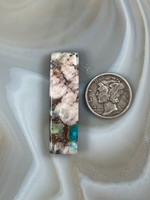
The Tortoise Turquoise & Variscite Mine
The Tortoise mine is a new mine in Nevada that we own and operate in partnership
with Nevada Turquoise Company. This mine produces stellar material!! We have
only started on This mine (we are only 5 feet down in the pit and are finding
AAA grade material! The Tortoise produces green, blue, brown, white, yellow
and red material with beautiful black spiderweb. We have determined that the
mint green and blue materials are Turquoise and the white material is Chalcociderite,
we are currently having the other materials assayed. We have vein material,
nuggets and nodules. We have pulled out several nodules the size of softballs,
and a piece of vein. that is 3ft x1 3/4ft x 2 inches thick! All the materials
have a hardness of between 6 and 8 on the mohs scale. When you see This material
you will fall in love! You want to see some gorgeous Turquoise jewelry, you
have to see this stuff in silver jewelry or in gold jewelry.
Mining
Tortoise Turquoise Video | More
Tortoise Information
More
Turquoise Information | Nevada
Mine List | Silver
Jewelry Information
More Turquoise Information | Nevada Mine List | Silver Jewelry Information
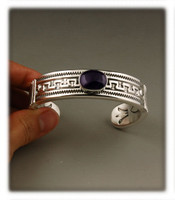
African Sugilite
Sugilite (aka Royal Azel, Royal Lavulite, Purple Turquoise, Luvulite,
Gem Sugilite, Royal Lazelle) is a somewhat obscure mineral named for the Japanese
geologist who discovered the first specimen in 1944, Ken-ichi Sugi. It is
a potassium sodium lithium iron manganese aluminum silicate (now that's a
mouthful!). Sugilite forms in syenite, a rock that was created through volcanic
activity deep beneath the earth's surface. It is usually opaque with a waxy
luster but can be translucent. It often has brown, pink and white inclusions,
looking like a purple version of turquoise (though the two minerals are unrelated).
The most valuable sugilite is a deep purple or reddish purple colors
it derives from manganese. However, some sugilite is gray, white or yellow.
These color variations are caused by quartz or various silicate materials
present. Warm soapy water is the best cleanser for this gemstone, as it is
risky to clean sugilite by ultrasonic machine or steaming. Sugilite has been
called the stone of the New Age. The variety Professor Sugi first discovered
in Japan in 1944 was a light brownish yellow. The second known occurrence
of sugilite came in 1955, when a single dark-red ore specimen with pink crystals
across its surface was found in central India. However, this specimen was
not identified as sugilite until many years later. It was not until 1975 that
sugilite was discovered in a significant quantity: a thin, bright-magenta
band running through a core sample obtained at a manganese mine in South Africa,
near a small desert town called Hotazel. Though this was a low-grade ore,
by 1979 a major deposit of gem-grade sugilite was exposed in the area. Most
of this original material has since been used up, making quality sugilite
a relatively rare item on the market. Only a few, much-smaller finds have
followed. Sugilite is considered a great balancer of mind, body and spirit,
and is said to attract healing power. Mystics say it helps with self-forgiveness
and brings forth acceptance and belief in oneself. It also is said to eliminate
hostility and infuse the being with inspiration and confidence. Yoga enthusiasts
believe sugilite stimulates the crown chakra and aids in opening all the chakras,
allowing for the movement of Kundalini energy. It is highly regarded for centering
spiritual light into the body and drawing out both physical and emotional
pain. Sugilite seems to protect against, absorb and dissipate anger. Many
also believe it will heal headaches and discomforts, simply by holding it.
Sugilite is found on Iwagi Island in Japan, Canada (Quebec) and most importantly,
South Africa. In recent years this gemstone has been used in all types of
jewelry from southwest jewelry to Victorian jewelry and is super hot in Zuni
inlay jewelry.
More Gemstone Information | Silver Jewelry Information
General Turquoise Facts | Turquoise Mines List | Turquoise Grades & Treatments | Turquoise Color Chart | Turquoise Healing | Turquoise Spiritual Facts | Turquoise Symbolism | Physical Properties of Turquoise | American Turquoise | Arizona Turquoise | California Turquoise | Colorado Turquoise | New Mexico Turquoise | Nevada Turquoise | Utah Turquoise | Chinese Turquoise | Persian Turquoise | Ancient Turquoise History | USGS History of Turquoise | Ribbon or Boulder Turquoise | Carico Lake Turquoise | Nevada Green Turquoise
Bead Jewelry | Gemstone Facts | Birthstones | About Turquoise Earrings | About Turquoise Rings | About Turquoise Gold Rings | Southwest Jewelry | Inlay Turquoise Jewelry | Mens Turquoise Bracelets | Royston Turquoise Jewelry | Vintage Turquoise Jewelry | Mineral Testing | Stones We Use In Our Jewelry
American Silver Smiths | General Native American Silversmith Information | Hopi History | Navajo Silversmith History | Santo Domingo History | Western Silver Information | Zuni Native American Jewelry | Mexican Silver Information | Chilchimbito Trading Post | Fort Defiance Trading Post | Why Buy From Us? | How Too Make Beads